How one rapper’s “Free Palestine” turned a stadium tour inside out in a single week — and why every artist who walked was right to.
Where Exposed Vocals stands, up front: with Macklemore, and with every artist who walked off this tour rather than lend a stage to a silence. Here is the week that made it an easy call.
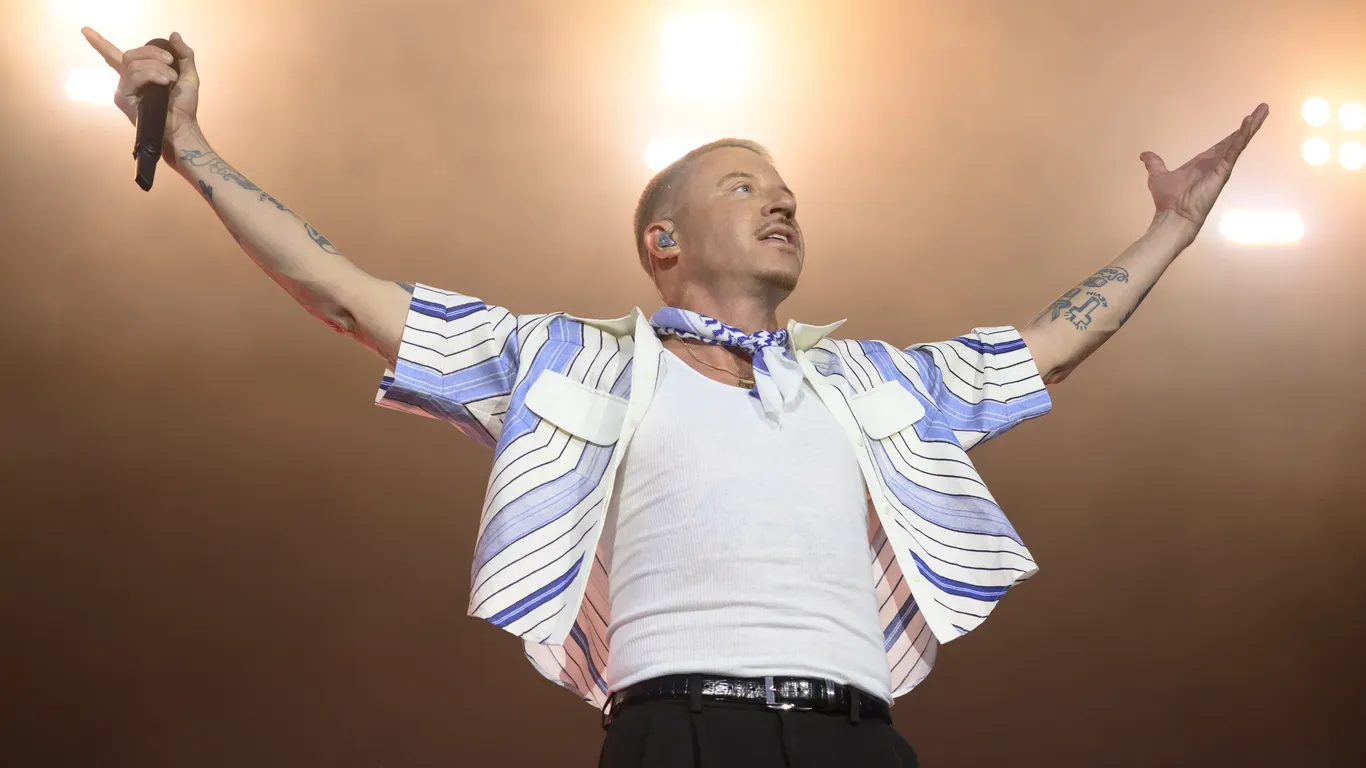
It took two words. On the night of September 4, in front of a packed MetLife Stadium, Macklemore leaned into the mic as Ed Sheeran’s opening act and said the thing a lot of powerful people had spent two years making very expensive to say: Free Palestine. Everything since is the story of what those two words cost — and of who decided to pay it right alongside him.
September 4–5 · MetLife StadiumThe moment
The set wasn’t subtle, and it wasn’t meant to be. Macklemore told the crowd he’d taken the tour precisely so he could stand in a room that size and say it, speaking directly to people from Gaza to the occupied West Bank. Then he performed “Hind’s Hall,” his 2024 protest song named for Hind Rajab, the six-year-old killed in Gaza, while footage from the war moved across the screens behind him. The next night he did it again — and paused to tell the Jewish members of the audience that criticism of a government, and opposition to the killing of children, was not and never had been an attack on them. It was about as clear a line as an artist can draw. The people who came for him afterward pretended not to see it.
September 14 · The removalMade to disappear
The backlash arrived on schedule. Pink reshared a call to drop him. The Israeli American Council circulated a petition. And then, quietly, the tour’s promoter announced Macklemore was off the remaining U.S. dates — eight shows, gone — in the flattened language of a corporate memo: venues wouldn’t allow a concert with him on the bill, so, after “discussions with stakeholders,” he was out. Nobody wanted to say the plain thing. But strip the euphemism and it’s simple. An artist said something, and the people who own the buildings made him vanish from them.
Follow the leverageThe name he said out loud
Macklemore refused to let it stay vague. In a long, unsparing Instagram statement, he named the man he says made the call — Patriots owner Robert Kraft — alleging Kraft phoned Sheeran, told him the words and the Palestinian flag were hurtful, and threatened to pull his stadiums if Macklemore stayed on the bill. Kraft didn’t deny barring him from Gillette; he confirmed it, framing the ban around his objections to what came off the stage. And Kraft’s record isn’t a secret: the 2019 Genesis Prize in Jerusalem, where Netanyahu called him Israel’s most loyal friend; a $20 million pledge to found an anti-antisemitism foundation; millions from his company to AIPAC’s super PAC. None of that proves the ultimatum. All of it explains how one man’s phone call could move a pop tour. That’s the machinery. It usually runs quietly. This week it left fingerprints.
The machine behind the manHow the lobby actually works
To understand how a single phone call could empty a stage, it helps to understand the machine the caller belongs to. Kraft’s checks to AIPAC’s super PAC aren’t the quirk of one sports owner; they buy into the most effective pressure operation in American politics.
For most of its history, AIPAC — the American Israel Public Affairs Committee — didn’t fund candidates directly. That changed in 2022, when it launched a super PAC, the United Democracy Project, and began spending at a scale primary races had never seen. In the 2024 cycle alone, AIPAC and its affiliated groups poured more than $100 million into U.S. elections. When two of Congress’s most outspoken critics of Israel’s war — Representatives Jamaal Bowman and Cori Bush — hit their primaries, the super PAC spent roughly $14.5 million to help defeat Bowman, the most expensive House primary in American history, and around $8.5 million to defeat Bush. In Bowman’s race, pro-Israel money outspent every other outside group combined by about ten to one. Both lost. “AIPAC, I’m coming to tear your kingdom down,” Bush said the night she went down. By one tally, AIPAC-backed candidates went 48 for 48 that cycle. Not one lost.
Sit with that number. A lobby that never loses isn’t winning arguments — it’s removing the people who make the other one. The method is legal and ruthlessly efficient: find a dissenting voice, bury it in money, and make the example vivid enough that the next hundred politicians quietly edit themselves before anyone has to spend a cent. Beating Bowman and Bush was never only about Bowman and Bush. It was about everyone watching.
And here’s the part that has to be said plainly, because the powerful blur it on purpose: none of this is “the Jews,” and pretending it is would be both a lie and a slander. This is an American super PAC, funded by American donors — some of its largest checks come from Republican megadonors and tech billionaires — advancing one foreign-policy line. Many American Jews fund it; many more organize hard against it. Collapsing a well-financed political operation into an entire faith is precisely the trick used to make criticism of the operation unsayable, and we decline to fall for it. The lobby is powerful because it spends and it punishes — full stop.
What happened to Macklemore is that same machine reaching past the ballot box and into the culture. Same playbook, different stage: locate the dissenter, apply the money and the leverage, and let everyone else absorb the lesson without a single word aimed at them directly. The stadium owners didn’t need a memo. They’d already watched what happens to people who don’t fall in line.
The turnThey wanted silence. They got a chorus.
Here’s what the machinery didn’t price in.
First it was Ms. Rachel — yes, the children’s educator — who looked at the whole thing and told Sheeran flatly that he’d caved, and that silence during a genocide “is not neutral.” Then the openers started walking. Aaron Rowe, the young Irish singer booked to help fill Macklemore’s slot, quit first, saying that as Irish people who know famine and occupation in their bones, he could not “carry on as normal” while billionaires silenced artists. Finneas — Billie Eilish’s brother and co-writer, set to open Sheeran’s South American dates — followed, saying artists must not be silenced for defending the oppressed. Then the Danish band Lukas Graham. Then Beoga, the Irish folk group that had been playing inside Sheeran’s own live set. By midweek, NBC News reported the only possible ending to that sentence: every single one of Sheeran’s listed openers had left. Kehlani, Greta Thunberg and a long line of artists lined up publicly behind him. And in Michigan, the mayor of Dearborn — the first Arab-majority city in America — offered Macklemore a free, city-sponsored stage. If the stadiums won’t have you, the message ran, we will.
September 15 · Sheeran answersThe trouble with “I don’t take sides”
Sheeran finally spoke, and it’s worth being fair to him. He says he didn’t make the call, that he won’t abandon a crew that depends on the tour for a living, that he’d rather his shows be a refuge than a battlefield. He insisted the removal was “the promoter’s decision, it was not mine,” and that he is not complicit. He said he was appalled by the war and called the suffering on all sides a human tragedy.
But that’s the whole problem. Neutrality, when one side is being erased, is not neutral — it’s a decision wearing the costume of no decision. The venues took a side. The billionaire took a side. The pressure ran one direction only, toward the exit, and only for the artist who spoke. When speech costs you the stage and silence keeps it, calling your silence “diplomacy” just gives the quiet a nicer name. Humanitarian groups and a United Nations commission have described Israel’s conduct in Gaza as genocide; Israel and its allies deny it. Macklemore chose a side in that argument. So — by removing him and calling it neutral — did everyone who owns a stadium.
The audience returned its own verdict, and it wasn’t close. Trackers argued over exactly how many followers Sheeran lost in the days that followed — the estimates ran from tens of thousands to a few hundred thousand, with no official tally to settle it — but while his numbers slid, Macklemore gained more than 400,000, and the acts who walked out added a combined 1.6 million. People vote with the follow button. They voted.
The bill comes dueWhat this costs Sheeran
For Sheeran, the damage runs deeper than a dip in his follower count. He is now, by his own promoter’s hand, a headliner with no opening act at all. All four walked: Finneas, the Irish singer-songwriter Aaron Rowe, the Danish band Lukas Graham, and Beoga — the Irish folk group that had been playing inside Sheeran’s own live set. A stadium show is a machine that needs those parts, and they pulled them out rather than share a marquee with the decision.
The costlier loss is who he’s alienated. Sheeran’s audience skews young, online, and progressive — the precise crowd most fluent in what’s happening in Gaza and least willing to accept a shrug. His “both sides” statement was written to cool the story; it poured fuel on it, because to the people filling his comments, calling the suffering a human tragedy “on all sides” during what a UN commission calls a genocide reads as a side. Sheeran built a career as pop’s likable everyman, the guy with no enemies. This is the first time in years that being no one’s enemy has cost him something real.
He’ll be fine in the crude sense — the tour rolls on, the stadiums fill. But a reputation is a slow, expensive thing to rebuild, and he spent a little of his to keep a billionaire’s venues open. That’s the bargain the machine offers everyone in the end: your conscience or your calendar. Macklemore chose one. Sheeran chose the other. Only one of them is gaining followers.
September 16The million-dollar answer
And then, on Wednesday, Macklemore answered the whole thing with a check. He announced he would give away the entire $1 million of his net earnings from the Loop Tour — every dollar the stage was supposed to pay him — to six organizations working directly for Palestinians: the Palestine Children’s Relief Fund, HEAL Palestine, Gaza Soup Kitchen, Medical Aid for Palestinians, UNRWA USA and Anera. Then he turned to the man who allegedly made the calls and invited Robert Kraft to match it. Whatever else they disagree about, he wrote, “Palestinian lives are worth protecting.” He called cutting the check one of the least costly forms of solidarity available to him, and asked people not to drift off when the news cycle does.
Kraft answered within hours — not by matching Macklemore’s gift, but by saying Sheeran had already asked him to match a separate $2 million humanitarian donation, and adding that he had spent his life building bridges and believed all lives were worth protecting. Read it however you like. Strip the framing, though, and the sequence is stark: the artist who got punished gave away the money he earned; the billionaire who did the punishing talked about bridges. One man put a number on his convictions this week. It wasn’t the one who owns the stadiums.
What’s still standingWhy this is our fight too
Here’s the part worth holding onto, and the part that should matter most to anyone who cares about independent music. The stadium economy is a machine built for scale, and machines route around friction. The voices that make a paying crowd briefly uncomfortable in the name of something true are exactly the voices that get optimized out of the biggest rooms. Which is precisely why those rooms can’t be the only ones. Exposed Vocals exists for the artists the arenas won’t risk — not because everyone will agree with every word (you won’t, and you shouldn’t have to), but because a culture that can only broadcast what its sponsors permit isn’t a culture. It’s a playlist with a legal department.
So let us be as clear as they were. Exposed Vocals stands with Macklemore. We stand with Aaron Rowe, with Finneas, with Lukas Graham, with Beoga — every act that walked off the biggest stage of their year rather than lend it to a silence. We stand with Ms. Rachel, who had plenty to lose and said it anyway, and with everyone from Kehlani to Greta Thunberg to the mayor of Dearborn who refused to let one voice be made an example of. We’re a small independent platform, and none of them need our cover. They have it anyway — no hedge, no asterisk, no “both sides.” Standing with artists who won’t be bullied out of their own conscience isn’t a hard call. It’s the whole reason a place like this exists.
They dropped the opener. They emptied the stage trying to keep him off it. And the two words are louder now than before anyone reached for the plug. Say what you want about Macklemore’s timing, his volume, his choice of moment — he said a true thing in the biggest room he could find, and when they punished him for it, better people than the ones who own the buildings stood up and walked out beside him. That isn’t a scandal. That’s the job.
— The Exposed Vocals Editorial Desk