Sixteen years after its release, Eminem’s anthem of resilience found a new stage in Michigan’s Senate election—raising a bigger question about music, politics, and the power of an artist’s message.
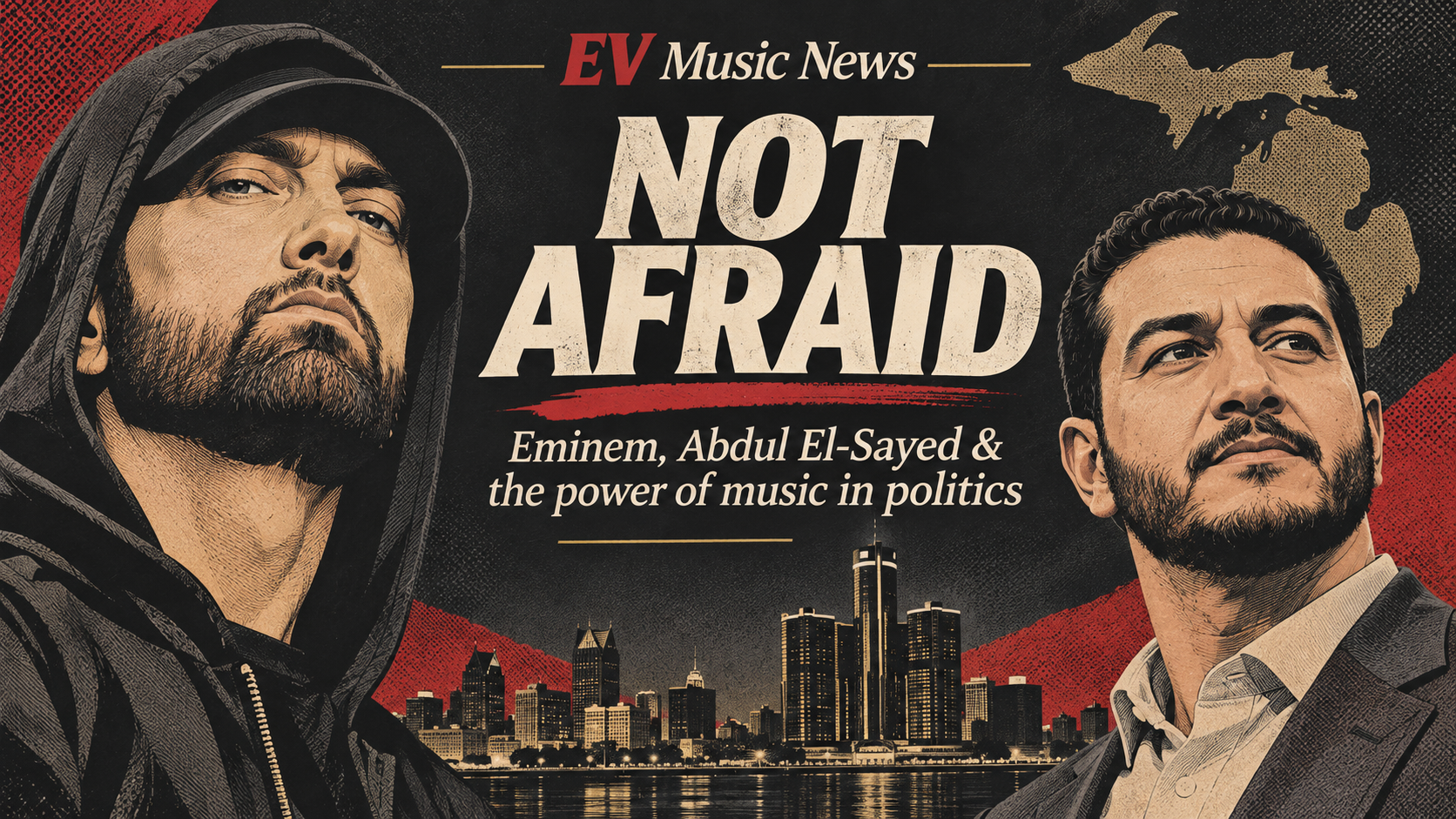
Featured image: Exposed Vocals editorial illustration. The composite does not depict a joint appearance or suggest an endorsement.
- Abdul El-Sayed used Eminem’s 2010 single “Not Afraid” in a November 3 Michigan Senate campaign video.
- An Eminem spokesperson said the campaign had not contacted his team about the music; no personal endorsement was announced.
- The moment highlights how music can carry political meaning beyond an artist’s original intentions.
On November 3, 2026, as Michigan voters headed to the polls, Democratic U.S. Senate candidate Abdul El-Sayed released a 78-second campaign video featuring one of the state’s most recognizable musical voices.
Eminem.
The soundtrack was “Not Afraid,” the 2010 hit from his album Recovery. Against a montage of campaign footage, the song’s message of standing tall, overcoming adversity, and refusing to back down took on an entirely different context.
As political storytelling, the choice was striking. But there was one important detail: Eminem had not publicly endorsed El-Sayed.
After initial reporting suggested that the campaign had worked directly with the rapper to secure the track, the Detroit Free Press issued a correction. An Eminem spokesperson said there had been no outreach from the campaign. Read the corrected report.
That distinction does not establish whether the campaign secured licensing permission through another party. It does, however, challenge the idea that Eminem personally approved the video or its message.
A song that was never written for an election
When Eminem released “Not Afraid” in 2010, it represented a turning point in his career. The song wasn’t about a political party, a ballot or a candidate. It was about recovery, confronting personal demons, acknowledging mistakes and finding the courage to move forward.
For an artist whose career had often been defined by confrontation and controversy, it was an unusually direct statement of personal change.
But great music has a way of escaping its original context. A song about overcoming addiction can become an anthem for someone battling illness. A song about redemption can inspire an athlete facing defeat. And a song about refusing to surrender can become the soundtrack to a political campaign.
The music doesn’t change. The circumstances around it do.
Why Michigan made the moment different
Eminem isn’t simply another celebrity whose song appeared in a campaign advertisement. He is a defining voice of Detroit. His career, artistic identity and cultural influence are deeply connected to Michigan.
For countless listeners, his work speaks to struggle, ambition, resilience and the determination to make something of yourself when the odds seem stacked against you. That association made “Not Afraid” an unusually resonant musical choice for a statewide campaign.
El-Sayed went on to defeat Republican Mike Rogers in the November 3 election, according to the Associated Press. There is no evidence that the video changed the election outcome. But the pairing illustrates how a familiar song can give political imagery immediate emotional weight.
A candidate can deliver a speech about courage. An artist can make an audience feel it.
When a song speaks without its creator
The discussion surrounding the campaign video brings up an important distinction between a song’s meaning and its creator’s personal beliefs.
Eminem has participated in political campaigns before: “Lose Yourself” appeared in a Joe Biden advertisement in 2020, and the rapper publicly backed Kamala Harris in Detroit in 2024. Yet past endorsements don’t automatically establish support for a new candidate. Complex reported on the latest distinction.
Music licensing, personal endorsements and artistic interpretation are three separate matters. A campaign’s use of a famous song can leave viewers with a sense of association even when the performer has not publicly endorsed the candidate.
Listeners also bring their own stories, identities and beliefs to music. An artist may intend one message, while an audience hears another. That freedom of interpretation is part of what makes music powerful.
But finding your own meaning in a song isn’t the same as having the right to use it in a political advertisement without appropriate authorization. Both artistic freedom and creators’ rights deserve recognition.
What independent artists can learn
For emerging musicians, the story is bigger than Eminem or one Senate election. It is a reminder that the life of a song doesn’t end when it is released.
An independent artist recording in a bedroom today might be creating something that becomes deeply meaningful to people they will never meet. A song written about one experience might eventually connect with a community, a movement or an entirely different generation.
That possibility is extraordinary. It is also why artists should understand their publishing rights, master recordings, sync licensing and the permissions needed when their work appears outside a typical streaming context.
You can control what you write. You can’t always control what it means to someone else.
The message outlives the moment
Sixteen years after its release, “Not Afraid” still carries the emotional force that made it resonate in 2010. The campaign put that message in a new setting, while the questions about Eminem’s involvement raised legitimate issues of consent and endorsement.
Political campaigns come and go. Candidates win and lose. The news cycle moves on. But the right music can stay with people for decades.
Eminem didn’t have to deliver a speech, stand behind a podium or endorse El-Sayed for listeners to recognize the message they had heard for sixteen years.
When a song becomes bigger than its creator, who gets to decide what it stands for?
Is the meaning defined by the person who made it—or by the people who find something of themselves in it?
Join the conversation on Signal →Sources & reporting
- Detroit Free Press — correction on campaign outreach
- Complex — spokesperson’s response and ad coverage
- Associated Press — Michigan Senate election result