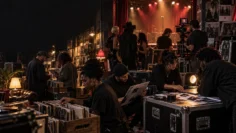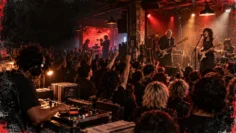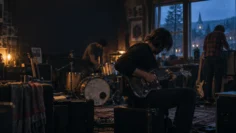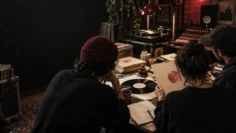

Vancouver noise-punk band PISS will release its debut album, you made me / skin on linen, on October 30 through Sub Pop worldwide and Paper Bag Records in Canada, placing one of the city’s most confrontational underground groups in front of a substantially larger audience without separating the music from the community that shaped it. The four-piece—vocalist Taylor Zantingh, guitarist Tyler Paterson, bassist Gavin Moya, and drummer Garreth Roberts—works across punk, poetry, sound collage, performance, and visual art, treating the album as a multidisciplinary examination of how structural, intimate, and systemic violence marks a life. Its first widely shared offering, “time loop at hot slit,” carries that purpose in both sound and setting: the official video was co-directed by Zantingh and Vivyen Sagsen and filmed at Take Yr Time Back, a now-closed Vancouver DIY space where members of the group’s local circle had already been singing the song with PISS for two years. That history matters because the announcement is not the story of a label manufacturing a new act from the top down. It is the story of work that developed in small rooms, among people who understood its language, before the wider industry arrived. The album was recorded in January 2025 with producer Colin Stewart at Hive Creative Labs, giving the band time to shape fifteen tracks that move through memory, rage, identity, and the unstable boundary between the wound and the person carrying it.
The release plan is as notable as the record itself. Alongside conventional vinyl, CD, digital, and Bandcamp preorders, PISS is working with autonomous spaces and radical community hubs across North America to distribute free physical copies. Buyers can purchase an additional discounted copy that will be donated to one of those spaces, turning a preorder into a small piece of community infrastructure instead of limiting the campaign to merchandise and chart positioning. The band has framed the project as an effort to make the record physically accessible while encouraging listeners to connect with independent, offline organizations in their own cities. That is an unusually coherent extension of the album’s politics: a record concerned with violence, isolation, and resistance is being distributed through places built around mutual support and collective action. The strategy also offers a useful counterpoint to the increasingly frictionless way music is consumed. Streaming makes a song instantly available, but it can flatten the circumstances that produced it. A donated record moving through a community space carries location, intention, and human contact with it. For an independent band stepping onto a globally recognized label, the decision protects the meaning of where the music came from while allowing the audience to grow. It makes the campaign itself part of the art rather than a neutral delivery system attached after the fact.
PISS is carrying that same intensity into an international run stretching from early September through November, including headline dates, festivals, and twelve shows supporting Dublin post-punk group Gilla Band. Stops include Philadelphia, Brooklyn, Boston, Toronto, Detroit, Chicago, Denver, Vancouver, Seattle, Reykjavik, Paris, Amsterdam, and London, with the album arriving in the middle of the route on October 30. That schedule will test whether a live experience developed in close-knit underground rooms can retain its force as the venues, borders, and expectations expand. The signs point toward a band interested in growth without dilution. PISS is not presenting anger as an aesthetic accessory or treating difficult subject matter as promotional shorthand; the songs, staging, video, physical distribution, and chosen community partners all reinforce the same point of view. The wider arrival of you made me / skin on linen therefore represents more than a debut-album announcement. It is an example of an underground group using increased reach to pull attention back toward the people and spaces that existed before the coverage. Independent music often worries that scale automatically weakens authenticity. PISS is attempting the harder version: scale the access, preserve the purpose, and make the new machinery serve the original community rather than replace it.