
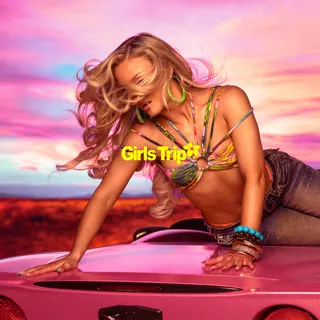
Zara Larsson
Midnight Sun: Girls Trip
Midnight Sun: Girls Trip is not just a remix album. It is a pop star successfully rewriting the narrative around her own relevance in real time.
There was a period — not even that long ago — where Zara Larsson occupied a strange space in pop culture. Everyone knew who she was, almost everybody remembered “Lush Life,” and yet her name somehow floated just outside the center of the conversation. Successful, recognizable, heavily online, but never fully crowned. Midnight Sun: Girls Trip changes that.
What makes this album fascinating is not simply the music itself, though much of it genuinely works. It is the timing, the positioning, the internet momentum surrounding it, and the way the project understands modern pop culture better than most major-label releases currently trying to dominate the algorithm.
The original Midnight Sun felt polished, colorful, and occasionally exciting, but it lacked gravity. It arrived during a moment when audiences are overwhelmed by highly curated pop releases, and despite its hooks and aesthetic confidence, it never fully pierced the noise.
Girls Trip solves that problem by understanding something increasingly essential about modern music culture: audiences do not just want songs anymore. They want ecosystems. Memes. Visual identity. Lore. Collaborative energy. Cultural participation.
This remix album transforms Midnight Sun from a standard pop release into an event. Suddenly the project feels social, fluid, internet-native, and self-aware in a way the original only hinted at. The features are not random celebrity add-ons — they are strategic world-building.
PinkPantheress, JT, Emilia, Madison Beer, Robyn — every appearance reshapes the emotional texture of the album while simultaneously expanding Zara’s orbit across multiple corners of modern pop fandom.
Girls Trip sounds like a pop star realizing the internet is no longer just reacting to culture — it is actively creating it.
What really elevates Girls Trip is how visually and emotionally coherent it feels. Even when the production swings wildly between hyperpop maximalism, glossy Europop, club textures, and softer emotional moments, the album maintains a unified personality: feminine, chaotic, self-aware, unserious in the smartest possible way.
There is a very specific type of modern pop record that understands the relationship between virality and sincerity. BRAT understood it. Pop 2 understood it. Parts of Future Nostalgia understood it. Girls Trip enters that conversation by recognizing that irony and emotional honesty are no longer opposites online — they coexist constantly.
The album’s bright neon atmosphere feels intentionally excessive, almost like a reaction against years of minimalist “sad girl” pop aesthetics. Everything here is louder, shinier, flirtier, and more socially alive. Even the weaker songs gain momentum through sheer personality.
And importantly, Zara herself finally feels fully centered inside her own aesthetic instead of chasing trends around her. That confidence changes everything.
The most interesting thing about Midnight Sun: Girls Trip may be that it accidentally reveals how pop stardom works now.
The original album did not fully explode. The remix ecosystem did.
A viral Olympic skating routine. TikTok edits. PinkPantheress momentum. Hyper-online meme circulation. Streaming recirculation pushing “Lush Life” back into conversations again. Suddenly Zara Larsson no longer feels like a legacy pop artist from the mid-2010s. She feels current.
That transformation is not artificial. It is algorithmic pop culture functioning exactly as intended — remixing identity itself until the artist re-enters the conversation with renewed force.
And to Zara’s credit, she handles that transition remarkably well. Girls Trip never sounds desperate for relevance. It sounds aware of relevance. There is a difference.
There is an obvious comparison hanging over this project: Robyn.
Not musically, necessarily. Robyn’s catalog remains emotionally sharper and more influential. But the broader trajectory feels familiar — a Scandinavian pop artist whose mainstream positioning fluctuated until she eventually found a stronger identity by leaning harder into herself instead of chasing expectations.
The difference is that Zara Larsson’s version of reinvention happens in a far stranger cultural environment. She is navigating algorithmic celebrity, meme acceleration, remix culture, TikTok aesthetics, stan ecosystems, and streaming-era attention spans all at once.
Midnight Sun: Girls Trip succeeds because it embraces that chaos rather than resisting it.