AETHERFALL on PARALLAX and an 18-Album Science-Fiction Saga
In this story
AETHERFALL is a science-fiction project built as a planned 18-album saga that follows a recurring heroine through a universe that keeps evolving, with music that evolves alongside her. PARALLAX is Chapter VIII, exploring choices and parallel lives through a blend of cinematic metal, 80s disco and electronic textures. Exposed Vocals previously featured AETHERFALL – PARALLAX (Official Video).
AETHERFALL’s creator and artistic director is open about the process: music and vocals are generated with Suno, arranged and mixed in Suno Studio, and paired with AI-created visuals. Here, AETHERFALL discusses the saga’s structure, the heroine’s visual identity, metal influences and the next chapter, DON’T REMEMBER ME.
PARALLAX explores parallel lives. What story does it tell, and where does it sit within the larger 18-album science-fiction saga?
AETHERFALL: PARALLAX is Chapter VIII of the planned 18-album saga. It explores choices and the lives that might exist on the other side of them. For our heroine, that means looking beyond a single version of herself: who could she have become if things had happened differently? Titles such as THE GIRL WHO NEVER FELL and I DIED IN ANOTHER LIFE express that idea directly. Musically, this chapter brings cinematic metal together with 80s disco and electronic textures. That change of sound belongs to the story. The heroine is evolving, her world is changing, and the music has to move with her.
An 18-album arc is a huge canvas. How did the saga first take shape, and how do you map out what each album needs to carry before you start making music for it?
AETHERFALL: The starting point was a desire to tell a story in which our heroine develops within a universe that is constantly evolving, with music that keeps evolving alongside her. That is the foundation of the whole project. The 18-album structure gives that journey room to unfold. Each chapter needs its own place in her development and its own musical identity, while still belonging to the same larger story. The connection between those three things — the heroine, the world and the music — guides the direction. I want listeners to feel that they are travelling through the saga, rather than hearing the same album repeated with different titles.
You build AETHERFALL with Suno-generated music and vocals, then arrange and mix in Suno Studio. Can you walk us through how a track like PARALLAX went from first idea to finished mix, and where your own decisions shaped it most?
AETHERFALL: The starting point for PARALLAX is the narrative idea of choices and parallel lives, together with the musical direction of cinematic metal, 80s disco and electronic textures. Those are the foundations for the prompts and the song's direction. Suno generates the music and vocals; arrangement and mixing are done in Suno Studio. My role is to guide the result towards the world and atmosphere of the chapter. The central creative decision is that combination of sounds and what it expresses within the story. I am open about the process: the vocals and instrumental performances are generated, and I do not present them as recordings of me singing or of a live band.
The PARALLAX video uses AI-created visuals. How did you develop its look, and how do you keep the imagery consistent with the world of the saga from release to release?
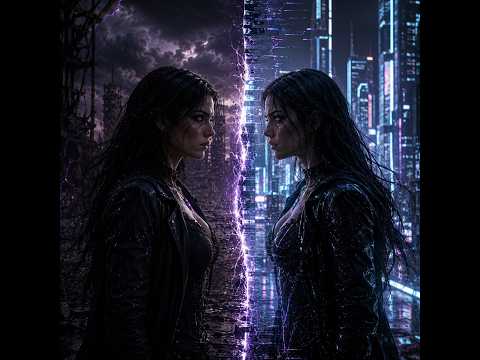
AETHERFALL: The visual side follows the same principle as the music: a recurring heroine in a world that can change around her. Her dark hair, violet eyes and dark, gothic identity provide a recognisable visual thread. Keeping her recognisable matters when the settings and atmosphere change between chapters. For PARALLAX, the idea of different possible lives gives that visual identity a particular purpose: the audience needs a connection to the same heroine across different possibilities. The images are AI-created, and I keep that clear in the way the project is presented. The aim is for the visuals to help tell the story alongside the music.
What drew you to science fiction as the language for this project, and which books, films, records or personal experiences feed most directly into the AETHERFALL universe?
AETHERFALL: Science fiction gives me the freedom to build a universe that never stands still. It allows the heroine's journey, the world around her and the music to change together. That possibility is what drew me to it for AETHERFALL. My metal influences include Amorphis, Nightwish, Visions of Atlantis, Rhapsody and Stratovarius. Metal is a major part of the project's musical foundation, but I want the story to have enough freedom to lead the music into different places. PARALLAX's combination of metal, disco and electronics is one expression of that freedom.
Working with AI tools raises questions about authorship. How do you describe your role as the creator behind AETHERFALL, and what do you want listeners to understand about how the project is made?
AETHERFALL: I describe my role as the creator and artistic director of AETHERFALL: developing the saga, its heroine and the connection between the narrative, music and visual identity. The tools are part of how I realise that project, and transparency matters to me. The music and voices are generated with Suno, arrangement and mixing take place in Suno Studio, and the visuals are AI-created. I want listeners to know what they are hearing and seeing, then decide for themselves whether the songs and the story connect with them. The ambition is to build a coherent musical universe that evolves over time, while being honest about how it is made.
Looking past PARALLAX, what comes next in the saga, and what can listeners expect from the next chapter, both in story and in sound?
AETHERFALL: The chapter immediately after PARALLAX in the story is DON'T REMEMBER ME, Chapter IX. The focus moves towards memory and identity, with titles such as THERE'S SOMEONE IN MY MEMORY, I REMEMBER A ROOM THAT NEVER EXISTED and SHE HAD MY FACE. Those titles give a sense of the questions that follow the parallel lives of PARALLAX. The guiding principle for the sound remains the same: it has to evolve with the heroine and the universe. I want each chapter to have its own atmosphere and to give listeners another part of her journey, while keeping the connection to the larger saga.
Signal this interview
Send it up if it hit, down if it missed. The most engaged pieces surface on Signal.
Keep reading
Back to Interviews ↗
From this section
Michael St. Over on Ride Sweet Angel, Hard Rock and Finding a Voice for Difficult Stories
October 22, 2026
From this section
Pam Ross on Outside the Box, Songwriting and the Stories Behind the Music
October 22, 2026
From this section