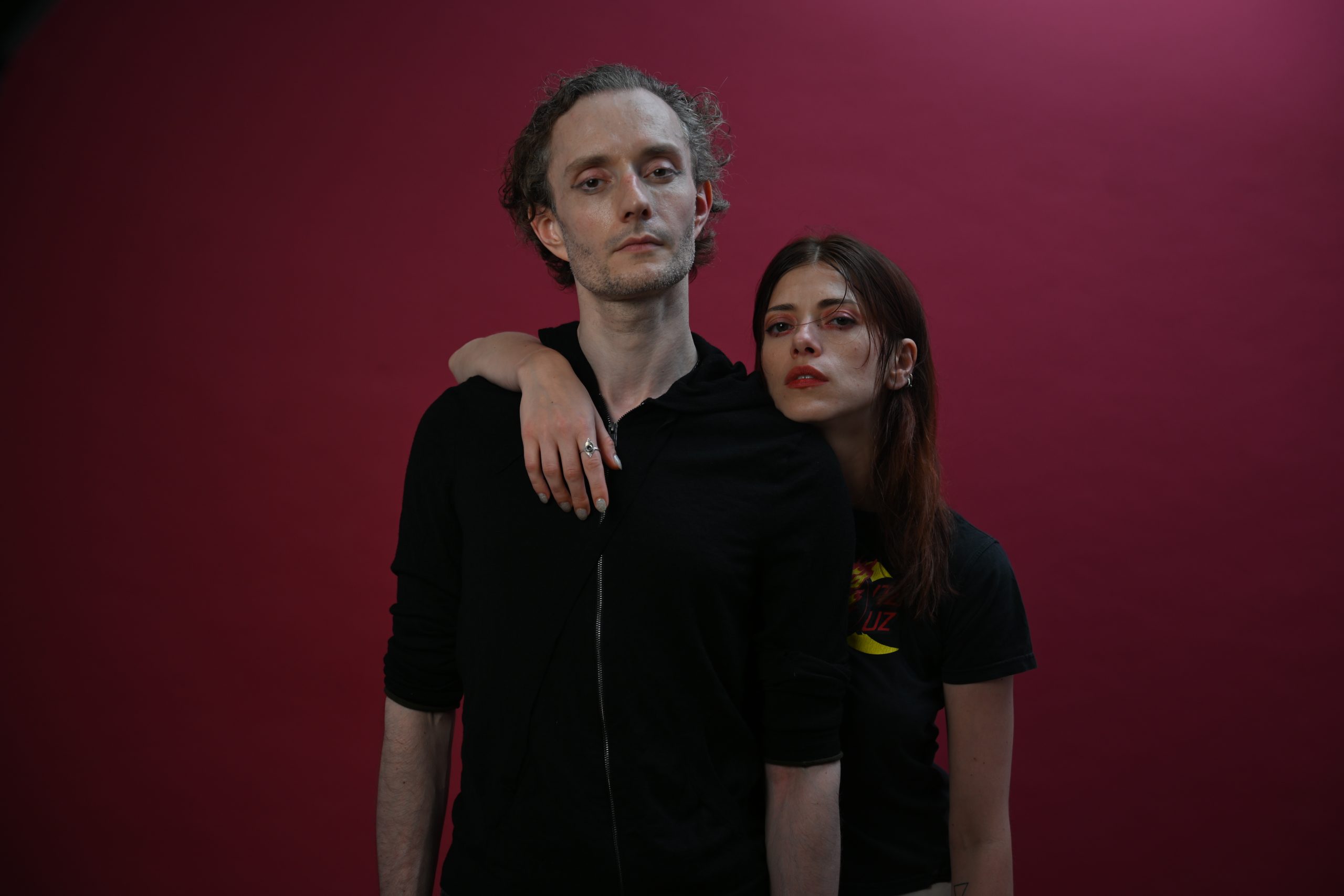
Nerisah is the duo of Mersiha Husagic and Nicolas “Nico” Rabine, a band that describes its sound as “nocturnal dust, with a taste of alternative rock” and sings in French, English and Bosnian. Their new single, “East Ghost,” began years ago as a song Mersiha wrote during a lonely period in Paris, carrying memories of a childhood in Bosnia, and it returned to focus as war came back into the headlines. Stripped of most of its planned arrangement, it leans on tambourines and three rusty cowbells instead of a drum kit, and its video was shot in a haunted hotel in England.
The pair’s story starts with a first show at the Highlander in Paris that went, by their own account, about as badly as a first show can. In the conversation below, Nerisah revisit that night, explain where the nocturnal dust comes from, and talk about holding warmth and grief side by side, letting each song choose its language, and leaving the human being audible in the recording.
EV: Your first appearance together at the Highlander in Paris was, by your own account, disastrous. What happened that night, and why did it make you more determined rather than less?
Nerisah: After a long wait to get onstage, and far too many beers to kill time and calm our nerves, we finally heard our band name being called around midnight. We’d almost forgotten the name ourselves, since Nerisah had only been born six days earlier.
First, Nico had problems with his effects pedal. Then, just before going onstage, his guitar strap broke. We spent far too long trying to sort out the sound with the sound engineer while the audience waited. Since Nico couldn’t stand with his guitar, he had to sit down. But when the pre-chorus came, he suddenly jumped up to shout his backing vocals into the microphone. Naturally, his guitar nearly fell to the floor. More chaos.
Then, halfway through the song, Mersiha suddenly stopped playing because she thought her guitar had been muted. She couldn’t hear herself. She was wrong. Everyone else could hear her perfectly.
The audience just stared at us. It was a very strange atmosphere.
EV: You describe your sound as “nocturnal dust, with a taste of alternative rock.” Where does that image come from?
Nerisah: When we rehearse, we turn off the lights. By nature, we’re some kind of nocturnal animals with electric guitars. The dust comes from our beloved old vinyl records.
And in the end, we’re all made of stardust anyway, as Joni Mitchell sang.
But to be completely honest, when our sound engineer asked, “What the fuck is nocturnal dust?”, we answered, “Maybe some kind of rock. Alternative, perhaps.”
EV: Mersiha, “East Ghost” was written years ago, during a lonely period in Paris, and came back into focus when war returned to the headlines. What made now the right time to release it?
Nerisah: To be honest, I never really believed my music was something I could put out into the world until I met Nico. I couldn’t believe there was someone who liked my songs exactly the way they were.
Before meeting him, I’d already written quite a few songs, but mostly for myself and my melancholic moments (and occasionally for my mother’s birthday).
After just three months of making music together, we already had around nine songs, and Nico came up with the crazy idea of recording an album. But then a series of unexpected problems made the whole album project more and more complicated.
And that’s when fate stepped in, or rather a strange chain of coincidences. East Ghost finally came to life in our third recording studio. It was the first song we actually finished. Around that time, I was researching ghosts and had booked a room in a haunted hotel in England. We ended up shooting the music video there, and a week later, it was Halloween.
Somehow, everything fell into place naturally. Or perhaps the ghosts arranged it.
EV: Can a song carry memories of a childhood in Bosnia without being weighed down by them? How did you find that balance in “East Ghost”?
Nerisah: War is the worst thing in the world to me. But my memories of Bosnia are also full of warmth and affection. There’s a bitter taste to them, of course, especially when I see that the country has never fully recovered the beauty it once had, the Bosnia I know from the stories of my parents and grandparents.
So my memories of Bosnia aren’t simply heavy. They’re much more complex than that. A cocktail of intense emotions, that’s for sure.
Nico and I both have a deep love of humour. Maybe that’s where the balance comes from — our stubborn belief in humour, even when things get dark.
Musically, we’re fascinated by contrasts. If there’s a dark, distorted guitar sound, you can be sure a little harp will come tinkling in somewhere nearby.
That’s Nerisah. Contrasts. Life and death. And occasionally a harp.
EV: You set most of your arrangement ideas aside and found that cowbells and tambourines served the song better than a drum kit. Can you take us inside that decision?
Nerisah: Another strange coincidence. I’m not particularly good at playing the drums, although we could have hired a professional drummer, as our sound engineer suggested. But somehow that felt wrong. Everything had to come from our own nocturnal, dusty hands.
So while recording some tambourine parts, I started tapping on various objects lying around the studio. Then I discovered a dusty old box that looked as though nobody had opened it in a century. Inside were three old, rusty cowbells.
I’d never played cowbells before and had no idea how to set them up, so I asked Nico to hold them. There were three cowbells, but unfortunately Nico only has two hands. He ended up holding the heaviest one with his little finger. A strong man, I can tell you.
We experimented with a few different rhythmic patterns, and suddenly, there it was: our very own East Ghost percussion sound.
EV: You sing in French, English and Bosnian. How do you decide which language a song belongs in?
Nerisah: Most of the time, the song decides. It has a mind of its own, and we’re merely its slaves.
EV: “We like music where you can still hear the human being inside it.” What does that mean in practice when you record, and what comes next for Nerisah?
Nerisah: First of all, being human means being imperfect. So instead of polishing the shit and the soul out of a song, we leave some of it in.
In East Ghost, you can hear that I’m not a professionally trained singer. You can hear me breathing quite a lot. Unfortunately, I’ve since learned how to avoid that in the studio. But we didn’t cut that out, even if we could.
We’re also not big fans of compression, even though we know it can make a song easier to listen to. We prefer to keep some of the rough edges, the little accidents, the things that remind you there’s an actual human being behind the sound.
Our next single, À l’ombre de la lune, comes out on November 22, 2026. The song is ready. We’re just having some scheduling difficulties with the demons we booked for the music video.
For Nerisah, “East Ghost” is the first song they finished together, a ghost story built from humour, contrast and three rusty cowbells. Their next single, “À l’ombre de la lune,” is set for release on November 22, 2026. Listen to “East Ghost” on Spotify and watch the official video on YouTube.
Signal this interview
Send it up if it hit, down if it missed. The most engaged pieces surface on Signal.