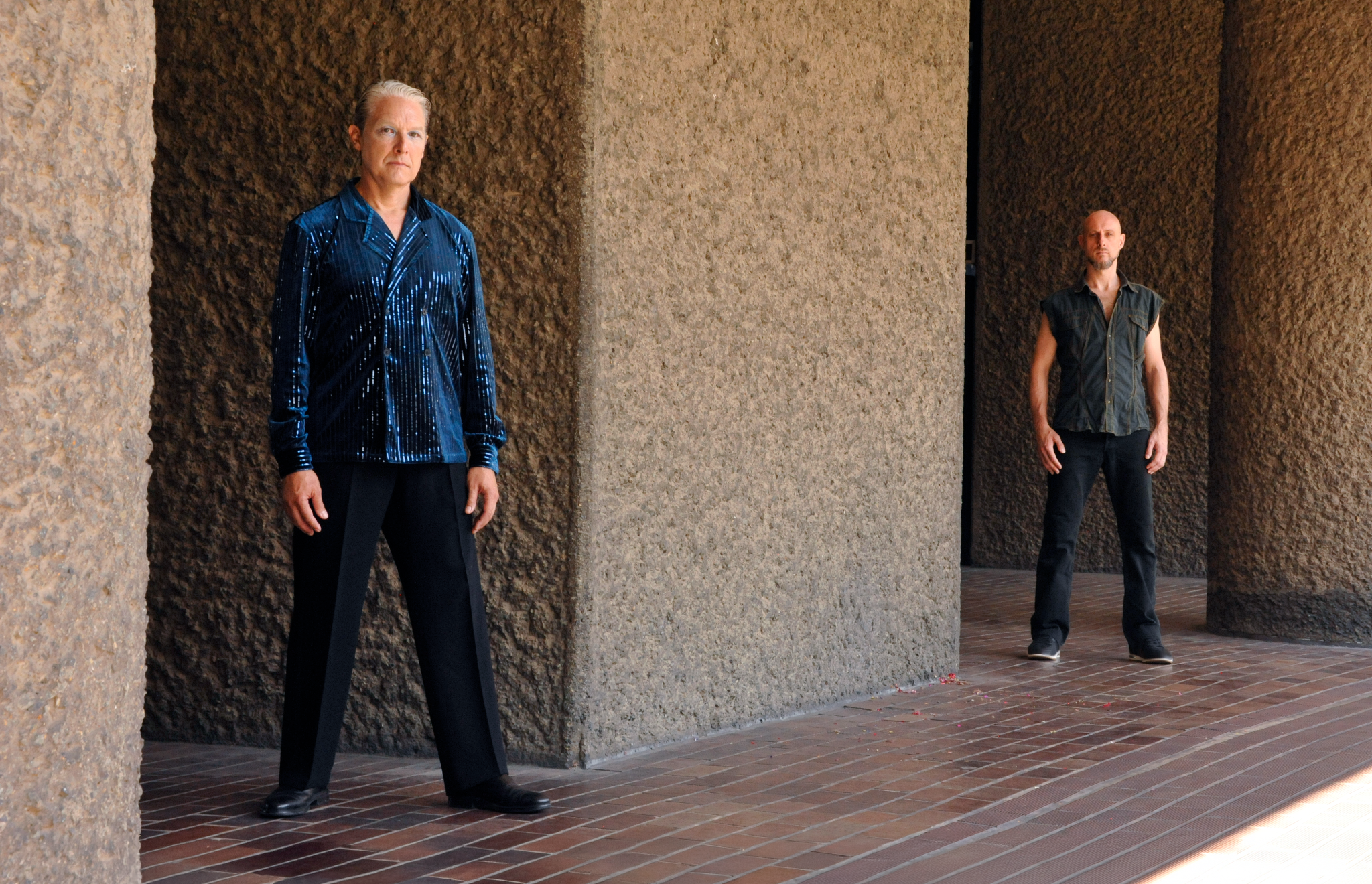
For Ten Centurions, a catchy song can carry an uncomfortable question. David Vaughan and guitarist Mauro Paderni built “F.G.G.T. (Feel-Good Gravy Train)” around a tension between surface pleasure and a lyric that challenges the pursuit of getting something for nothing. In Vaughan’s account, the hooks are an invitation to look more closely at what the party is celebrating.
The single points toward Dreambirds, their forthcoming debut album. EV spoke with Vaughan about discovering the right setting for his baritone, the lessons of an audition with Spandau Ballet, his creative exchange with Paderni and why he wants the album to unfold as a complete journey.
EV: How did Ten Centurions start, and where does the name come from?
David Vaughan: Ten Centurions started as an attempt to focus on a new sound and a new genre for both my own songwriting and for my work with the guitarist Mauro Paderni. We had previously performed and recorded together as part of a more conventional rock band, under my own name, which I fronted as both lead vocalist and keyboard-player. The new band name was my own idea based on initial demos for the project that suggested a sense of power and mystery. The vision of strong, sturdy soldiers came to mind, so I thought of centurions. Then I thought… why not just ten instead of a hundred?
EV: “F.G.G.T.” sounds like a celebration of the high life but takes a swipe at getting something for nothing. What prompted that?
David Vaughan: When songwriting, I always write the music before the lyrics. The initial demos for F.G.G.T. had something very catchy about them, but also something nonchalant and superficial. I knew I was onto a strong ‘poppy’ song, but didn’t want it to just fall into stereotypes, especially given the obvious Eighties musical references, so I resolved to both structure the song in unconventional ways and write lyrics that were intentionally at odds with the vibe of the music. I wanted to critique the very pocket-lining attitudes that underpinned so much of Eighties hedonism, attitudes which in my view are still around us today, although they have become less brash with age.
EV: How do you balance the glitz of the music with the bite of the lyric?
David Vaughan: The contrast of the music with the real message of the lyrics is for the listener to discover. If they don’t, they will have probably just taken the song at face value. If they do, they will have understood that a much more unsettling experience has been attempted, one that ‘lays on’ a whole host of pop music hooks and grooves to lead the listener into a ‘partying’ atmosphere, but then abandons them to a harsher, more disorientating reality. The big ‘party’ that in many ways the Eighties symbolised in the West, fuelled by liberalisation both within society and within the finance sector, has now been shown to be palpably ingenuous. Only now are we realising the cost, hence the lyric “They say that nothing’s ever really for free; They’re onto something if you take it from me”.
EV: What draws you to ’80s synths, and how do you keep that sound from feeling like nostalgia?
David Vaughan: Probably, the best way to make sure the Eighties synth sound isn’t just nostalgia is to make sure I don’t listen to too much Eighties synth pop! It is not really a favourite genre of mine, but I recognise that elements of it are really catchy and creative. In the end, it is synthesisers themselves that I find so fascinating. The alternative sound colours and rhythmic possibilities offered by the whole gamut of sound synthesis techniques now available, all within the context of computer-based sequencing, is a huge pull for me. I have also found, with time, that my voice is particularly well-suited to those sound colours.
EV: David, how did you find your baritone, and which singers shaped it?
David Vaughan: Understanding the nature and scope of my voice has been a lifelong affair, and only really began to bear fruit with Ten Centurions and the move into synth-based songwriting. I was not a born singer by any means. It was something foreign to me for many years, years in which I experimented with other genres that attracted me more at the time – jazz fusion, latin, conventional pop, and melodic rock. But in the process of putting together the first Ten Centurions EP, I began to realise that there was a particular way of singing – dark, slow, robust and expressive – that suited my voice really well and drew from a deep well in artistic and emotional terms. There were obvious comparisons. Many would mention David Bowie, David Sylvian, or Scott Walker when hearing my voice, all of whom I have listened to to varying degrees, although never avidly. But fundamentally, I was after something that had to be learned from within, so that became the process.
EV: What was it like auditioning for Spandau Ballet, and hearing Gary Kemp call it a “superb voice”?
David Vaughan: The whole Spandau Ballet story seemed rather surreal at the time, although clearly very exciting. I was a teenager in the Eighties, and Spandau Ballet were a big, big band back then. I had my reservations from the beginning, however. Having spent so long trying to find the right writing style for my voice, and after many failed attempts at singing other people’s songs, I wasn’t at all sure I was the right match. But I could only try and see. The audition itself was held in a secret West London location that the band use for rehearsal and videography. It was essentially a TV studio. It was very daunting and I didn’t perform as well as I hoped I would. I had a set choice of songs to sing, which were first rehearsed with the keyboard-player, then with the whole band. As it became clear I wan’t the right choice, the energy and enthusiasm drained. But everyone in the band was friendly and happy to have me there. Gary Kemp remained hugely supportive of my abilities as a singer. His message in the end was to keep doing my own music, that that was where I would find my true path.
EV: Your first EP caught Rusty Egan’s attention. How did that happen, and what did it mean for the band?
David Vaughan: I hadn’t heard of Rusty Egan until I researched synth pop radio shows and came upon his Electronic Family Tree show. After submitting the EP release to him, he got back to me with great enthusiasm. When he aired music from the EP, he already did so with the tag line, “Could this be the next Tony Hadley?”. I never actually considered that behind the scenes he might be planning to get me hitched up with Spandau Ballet, but it was his call that made it all happen. His input was easily the most significant thing to happen as a result of the EP release and he went on to do a cover of the EP song My Final Stitch in Time using my vocal track. He also showcased me with the track in an event at PizzaExpress Live in Holborn. We were definitely pleased to have the attention, but with the absence of new releases it eventually died down.
EV: How do the two of you split the work when writing and recording?
David Vaughan: Ten Centurions has always been a bit of a one-sided duo, but this has never been a problem. Mauro has always been happy for me to take the lead on writing and recording, and this debut album was no different. Nonetheless, Mauro Paderni has always been the first to hear my ideas and the first to give feedback. When we then start working on the guitar lines, he finally comes to the fore, offering no end of creative ideas and advice on how to make the most of them. With this album, I developed the initial sequenced demo versions with vocals on my own, and as I progressed through each song, Mauro first gave me general feedback before then attempting some initial guitar tracks, either with me in my studio, or online from his own studio. This whole process itself took many months but it was easily the happiest and most creative time. We love working together. We even joke about spending our last days in Venice together. It is, in an unspoken way, a musical romance of sorts.
EV: What can you tell us about Dreambirds, and how does “F.G.G.T.” fit into it?
David Vaughan: I have always believed that the great albums are those that make little sense if you hear the songs individually. They also fail to ‘desert’ the listener after the third or fourth song. The quality of the writing must be as good at the end as it is at the beginning. And there must be a journey that encompasses a variety of emotions and themes. For this reason, choosing the songs to work on for Dreambirds was a careful process that needed to give equal favour to the strength of the musical ideas and the variety of mood and message that each offered up. My co-producer, Fabio Trentini, was also a fundamental advisor in this respect. In fact, the album was initially conceived as an 11-song record, with one more original and a cover song too. I was advised to drop both of these by Fabio, and I am really happy to have done so. Now, each song has a different role to play, and does so brilliantly, all at differing stages of the album journey. F.G.G.T. comes in early on and is, in many ways, an outlier – more ‘full of itself’ as a song compared to all the others. But it helps to offset the more serious and earnest songs in the album, which I think is important. A message over-stated is better not stated at all, in my view.
EV: Will you be playing live ahead of the album’s release in 2027?
David Vaughan: I have every intention of at least doing some solo PA performances of tracks from both the EP and album in the run-up to the full release, and subsequent to it. Details of these will be made available nearer the time. Unfortunately, however, it will not be possible to bring together a full stage version of Ten Centurions until it becomes financially viable to do so. The fact remains that the Ten Centurions sound is elaborate and dense, and requires huge attention both to its musical delivery and its mixing and amplification. It is a big ticket item that deserves a big ticket presentation. I am confident that this will eventually be possible, but it will take time still.
Vaughan describes Dreambirds as a record whose songs need one another, rather than a collection of isolated singles. “F.G.G.T.” introduces that larger conversation through its deliberately uneasy relationship between enjoyment and meaning. Listen to the single and follow the project through Ten Centurions’ official website.
Signal this interview
Send it up if it hit, down if it missed. The most engaged pieces surface on Signal.