Dust and Grace: Michael Stover on Country Storytelling, Heartbreak and Second Chances
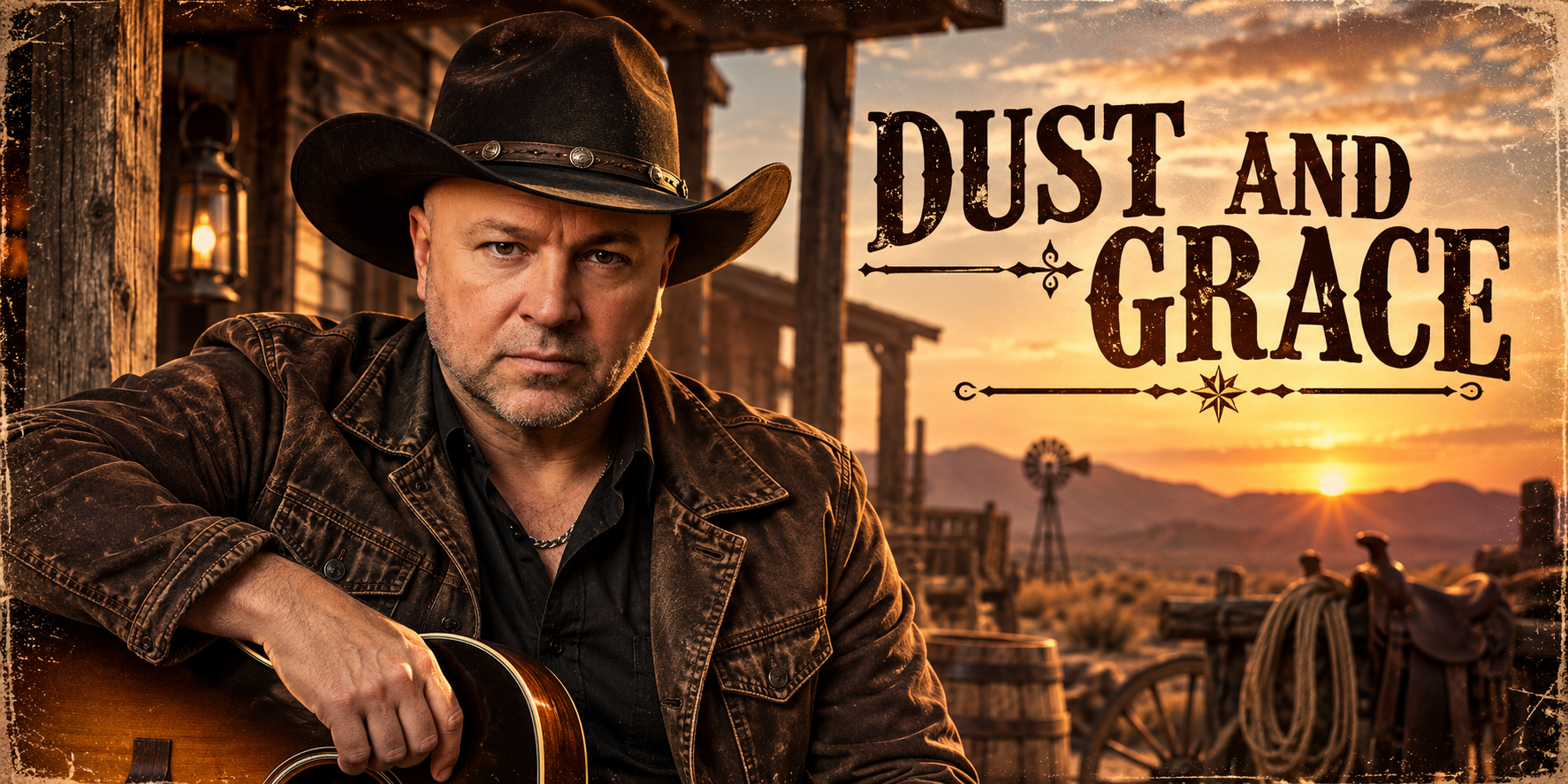
Dust and Grace is Michael Stover’s country songwriting outlet, but its name is also a compact statement of purpose. “Dust” acknowledges mistakes, struggle and ordinary human imperfection; “grace” offers forgiveness and the possibility of beginning again. Stover, who has spent years working with country artists through MTS Management Group and MTS Records, wanted a place to tell stories about families, heartbreak, faith and everyday life without asking every song to carry the same emotional weight.
That range is apparent in the contrast between “Trailer Park Paradise,” a playful celebration of making a good time out of modest circumstances, and “Love Doesn’t Live Here,” a quieter account of a relationship that has ended emotionally before the people in it fully separate. The latter was the first country song Stover wrote, and he still considers it foundational. We spoke with him about storytelling, the radio remix that gave the song a fuller arrangement, his Pittsburgh perspective, and why he thinks the right voice for a song matters more than a recognizable name.
Listen / Explore: Dust and Grace
Explore the music and releases discussed in this interview.
EV:Why start a country project, and why call it Dust and Grace?
I’ve always loved country music. I’ve spent years working with country artists through MTS Management Group and MTS Records, and I’ve written songs across several genres. But country music has a special way of telling stories that connect with everyday people. I wanted an outlet for songs about faith, family, heartbreak, small-town living, and the things that really matter.
The name Dust and Grace represents the two sides of life. We’re all made of dust, so to speak. We’re imperfect, we make mistakes, we struggle, and sometimes we fall flat on our faces. But there’s also grace—God’s grace, forgiveness, redemption, and second chances. I think those two words describe the human experience pretty well. And honestly, they sound like a country band, too!
EV:"Trailer Park Paradise" is playful. What’s the true story behind it, if there is one?
I wanted to write something fun that celebrated people who don’t have a lot of money but know how to have a good time. There’s this idea that paradise has to be some expensive resort in the Caribbean, but I’ve known plenty of people who can turn a backyard barbecue, a cooler full of beer, and a little music into the best vacation you’ll ever have.
There’s definitely a Jimmy Buffett influence in there, but with a more down-home, working-class twist. It’s about finding happiness where you are instead of always chasing something bigger. I love that kind of humor in country music. Not every song has to make you cry or question your existence. Sometimes you just want to kick back, laugh, and enjoy life.
EV:"Love Doesn’t Live Here" treats a breakup as a quiet ending rather than a fight. Why
tell it that way?
Because I think that’s how a lot of relationships actually end. It’s not always some huge argument or dramatic confrontation. Sometimes the love just disappears, and one day you realize that you’re living with someone who’s become a stranger.
The song is about a woman who leaves and then decides to come back, but the man has already moved on emotionally. He’s not necessarily angry anymore. He’s just done. And I think that kind of acceptance can be more powerful than anger.
I’ve been through enough in my own life to understand that not everything gets a happy ending, at least not the ending you originally imagined. Sometimes the healthiest thing you can do is close the door and move forward. That’s really what the song is about.
EV:Why did the song need a radio mix?
I loved the original version, but I felt like there was an opportunity to make it bigger and more impactful for radio without losing what made the song special.
We added some additional keyboard textures to fill out the sound, and we made the harmony guitar solo more prominent. I’m a sucker for those big, melodic guitar harmonies. I wanted that solo to really soar and provide an emotional payoff.
The important thing was not to overproduce it. The lyrics and melody are still the stars of the show. The Radio Remix just gives everything a little more depth and punch. Sometimes you don’t need to reinvent a song. You just need to bring out what was already there.
EV:Who performs on the debut LP, and how did you cast the voices?
Dust and Grace is really a songwriter-driven project. I wrote the material, and the goal was to give each song the voice and musical personality it needed rather than force everything into one particular sound.
I’ve always approached music from the standpoint that the song comes first. Some songs need a rougher, more traditional country delivery. Others benefit from a smoother, more contemporary approach. The important thing is whether the performance makes you believe the story.
I wanted the album to feel cohesive, but I also wanted each track to have its own identity. It’s a little like casting a movie. You want the right voice for the right character. For me, the emotional connection matters more than having a recognizable name attached to the performance.
EV:How does Pittsburgh shape a country record?
People sometimes forget that Pennsylvania has a pretty strong country music tradition, especially once you get outside the major cities. Western Pennsylvania is full of hardworking, blue-collar people who understand the themes country music has always celebrated.
Pittsburgh is a city built on steel, determination, family, and resilience. Those are country music values if I’ve ever heard them.
I think growing up around that environment gives you a different perspective. You appreciate people who work hard, take care of their families, and keep going when things get tough. There’s a certain grit here that I think comes through in my writing.
You don’t have to live in Nashville or Texas to understand country music. You just have to understand people.
EV:How does writing country differ from writing for Michael St. Over or Ashes Awaken?
The biggest difference is the way I approach the message and the emotion.
With Michael St. Over, I tend to write from a more personal, rock-oriented perspective. Those songs can be darker, more aggressive, and more autobiographical. It’s an outlet for things I might not express the same way in another genre.
Ashes Awaken is much more direct about my Christian faith. It’s heavy music with a message of redemption, salvation, and surrender to Christ. I love the contrast of aggressive metal music carrying a message of hope.
Dust and Grace gives me an opportunity to tell stories. I can write about a broken relationship, a family struggling to get by, a backyard party, or somebody finding their way back to God.
But underneath all three projects, it’s the same songwriter. I’m still interested in redemption, human weakness, perseverance, and finding hope in difficult circumstances. I’m just using different musical languages to tell those stories.
EV:Which country songwriters do you measure yourself against?
That’s a dangerous question because you’re talking about some pretty incredible writers! I have tremendous respect for people like Kris Kristofferson, Willie Nelson, Merle Haggard, and John Prine. Those guys could take something incredibly complicated and express it in a few simple lines.
I also admire the storytelling of Dolly Parton and the emotional honesty of Johnny Cash. And I’ve always loved writers who can inject humor into a song without making it feel like a novelty record.
I’m not going to pretend I’m in their league. But I absolutely study what makes their songs work.
For me, a great country song should make you feel something. It should make you laugh, cry, remember somebody, or think about your own life. If I can accomplish that, even on a small scale, I feel like I’ve done my job.
EV:What’s the song on the album you’re proudest of, and why?
That’s like asking a parent to pick a favorite child! But I’d have to say "Love Doesn’t Live Here" holds a really special place in my heart because it was actually the very first country song I ever wrote.
I’ve been writing music for years, across different genres, but that song was really my first step into country songwriting. I wanted to tell a story that was simple, honest, and relatable. Something that didn’t need a lot of fancy words or complicated imagery to get its point across. Just a real story about heartbreak, acceptance, and realizing that sometimes there’s no going back.
Looking back, I think that song helped establish the foundation for what Dust and Grace would eventually become. It showed me that I could take the emotions and experiences I’d been writing about in rock music and express them in a completely different way.
I’m also incredibly proud of "Hallelujah," especially with the recognition it’s received from the Independent Music Network. That song really represents the faith and gratitude side of the project. And "Little Footprints" is another one that’s close to my heart because of its message about family and how quickly time passes.
But "Love Doesn’t Live Here" will always be special. It was the song that started this whole country music journey for me. No matter how many songs I write or where Dust and Grace goes from here, I’ll always remember that one as the beginning.
EV:What’s next for Dust and Grace?
More music, definitely. I’ve got plenty of ideas, and I feel like we’re just scratching the surface of what Dust and Grace can become.
I’d love to continue exploring the balance between traditional country storytelling and a more contemporary country-rock sound. I also want to keep writing songs that reflect real life—the good, the bad, the funny, and the heartbreaking.
I’m grateful for the response we’ve received so far, from the chart activity to the radio support and the people who’ve taken the time to listen. But I don’t want to get so caught up in numbers that I forget why I started doing this in the first place.
At the end of the day, I want to write songs that mean something. If somebody hears a Dust and Grace song and feels a little less alone, finds a reason to smile, or reconnects with their faith, that’s worth more to me than any chart position.
And if we can get a few people singing along at a backyard barbecue in the process, that’s not a bad bonus either!
For Dust and Grace, authenticity is not confined to one mood. Stover can draw on Jimmy Buffett-style humor for a backyard-party song, then turn to the uneasy silence of a breakup or the spiritual gratitude of “Hallelujah.” He also names writers such as Kris Kristofferson, John Prine and Dolly Parton as examples of how direct language can carry complicated feelings. The ambition is not to imitate them, but to make each story recognizable to someone living through it. That gives the project room to grow without losing its center: country music as a way of noticing ordinary lives.
Photo credit: Courtesy of MTS Management Group.
Signal this interview
Send it up if it hit, down if it missed. The most engaged pieces surface on Signal.
Keep reading
Back to Interviews ↗From this section
Exposed Vocals Interview: RIZZ SA on Ambition, Soweto and the RizzVerse Movement
October 22, 2026
From this section
Bonnie Milne on “Glimpses,” “Coco in Motion” and Writing Music From Life
October 22, 2026
From this section