Two Worlds, One Room: ETAI and Felipe Pantone Collide at Albertz Benda LA
Felipe Pantone
Two artists. Two completely different worlds. One room in Los Angeles where neither of them blinks first. That is what Parallel Practices is — and it is worth paying attention to before it opens.
Felipe Pantone started on the streets. At twelve years old he was already pulling graffiti, already obsessed with movement and color in ways that most artists spend decades trying to articulate. He eventually formalized that obsession — Fine Art degree from the University of Valencia, international exhibitions, walls and galleries across the world — but the core never changed. His work is about how we consume visual information. How the eye moves. How color at velocity becomes something almost physical.
ETAI is operating in a different register entirely. Founded in 2023 by Etai Drori in Los Angeles, the brand lives at the intersection of fashion and design — Japanese denim, Mongolian cashmere, luxury materials treated not as status symbols but as canvases. Drori has built a reputation for deconstruction and reconstruction, taking what already exists and making it say something new without erasing what it was.
The reason this collaboration works — at least on paper, and likely in person — is that Pantone and ETAI are not being asked to blend into each other. Parallel Practices is not a stylistic merger. It is a structural dialogue. Each artist keeps their own methodology intact while allowing their work to sit in proximity, creating friction, overlap, and moments where one practice illuminates the other.
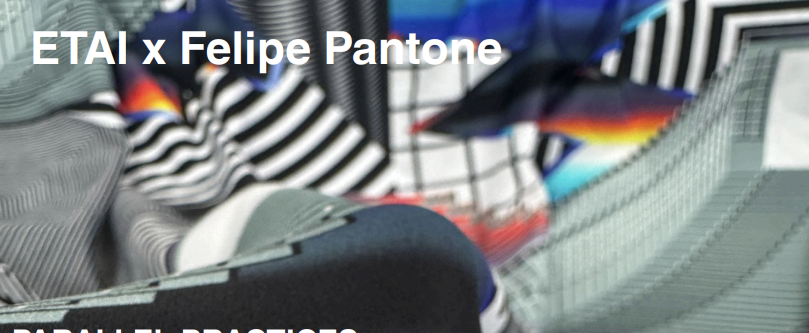
The process itself is worth noting. ETAI sourced mid-century furniture from across Los Angeles, digitally mapped each piece, and used those maps as the starting point for transformation. Pantone designed custom fabric elements produced by Italian textile house Limonta. From there the objects were deconstructed and rebuilt — not into something unrecognizable, but into something that carries the logic of both practices simultaneously.
Pantone’s wall-based kinetic works anchor the space visually. His optical effects — built from rhythm, repetition, and the moiré-influenced sensation of movement — establish a visual language that then bleeds directly into the printed fabrics carried throughout the room. The gallery becomes a single connected system rather than a group of objects sharing square footage.
This is not two artists sharing a room. This is two independent systems running in parallel until the walls between them start to dissolve.
The setting matters too. Albertz Benda’s Los Angeles location is housed in a mid-century modern home — a domestic architecture rather than a traditional white-cube gallery. That decision is not incidental. Work about intimacy, use, and lived experience lands differently when it is placed inside something that already carries those associations. The furniture is not just furniture. The walls are not just walls. Everything is in conversation.
For the EV audience — people who care about independent creative vision and artists who refuse to be flattened into a single category — this exhibition is worth tracking. Pantone built his reputation without waiting for permission. ETAI is doing the same thing in fashion. What happens when two artists like that finally occupy the same space is rarely predictable, and that is exactly the point.