
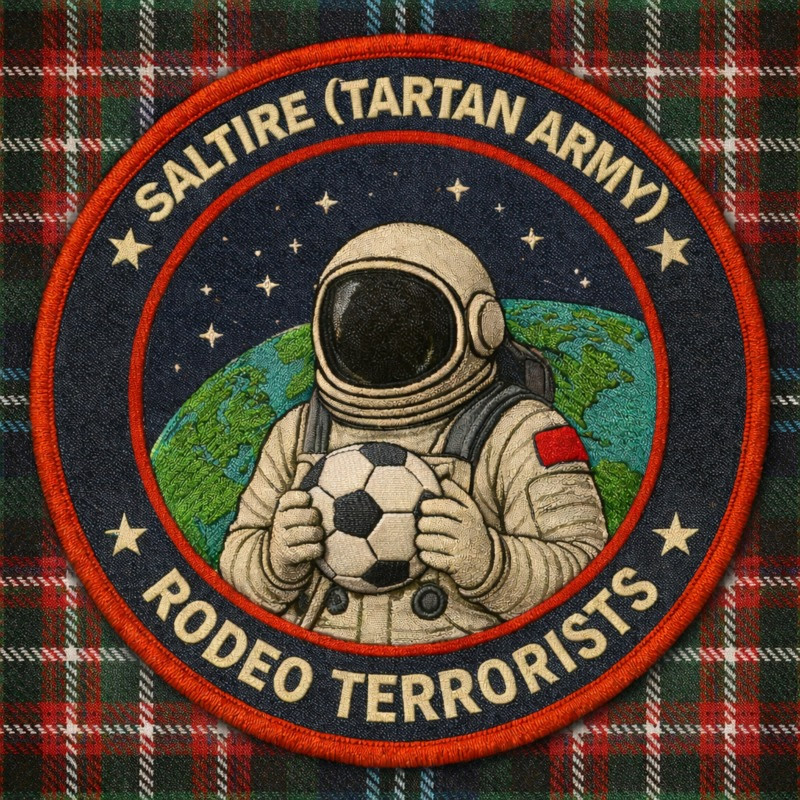
Rodeo
Terrorists
A 55-year-old English IT manager who built websites for Britney Spears, wrote Scotland’s World Cup anthem in 30 minutes on a lunch break, and is donating proceeds to MND Scotland in memory of a friend. Some songs are bigger than the artist making them.
Richard Barclay is not the person you’d predict to write Scotland’s most infectious 2026 World Cup anthem. He is English, 55, works in IT, and built websites for Britney Spears, Backstreet Boys, NSYNC and Steps during the pop industry’s glossiest era. He studied in Scotland, fell in love with the country, and has quietly considered it a second home ever since. When the draw was made and Scotland’s campaign started building momentum, he sat down during a work break, opened GarageBand and a few AI tools, and in 30 minutes wrote “Saltire (Tartan Army)” — a Celtic-electronic-pop hybrid with terrace-ready hooks, references to Kenny Dalglish football cards, and more genuine warmth than most officially commissioned anthems manage in months of development.
The track is already picking up radio play internationally — including in Brazil, one of Scotland’s group rivals — and has earned coverage from Plastic Magazine, Lyrical Odyssey, Bored City, and others. Underneath all the fun, there’s something more personal: Richard is using the single to raise awareness of Motor Neurone Disease and fundraise for MND Scotland in memory of a close friend he lost to the illness. It’s a feel-good record with a real reason to exist.
“It’s one of those tracks that doesn’t take itself too seriously, but still hits in the right way. You can imagine it working well in a crowd or even on TV highlights.”— Bored City
From Britney’s Website to the Tartan Army
Before Richard Barclay became the Rodeo Terrorists, he was the invisible architecture behind some of the biggest pop acts of the early 2000s — the person building and maintaining the digital presence of Britney Spears, Backstreet Boys, NSYNC, and Steps while the world was focused on the faces. It’s a career that required an unusual combination of technical precision and an instinctive understanding of what an audience responds to. Both qualities show up in “Saltire (Tartan Army),” even if the production circumstances were considerably more kitchen-table than anything those acts ever released.
The Rodeo Terrorists project started in the summer of 2006 when Richard got his first Apple Mac on a rainy day, got drunk on home-brew beer, and discovered GarageBand. The influences that shaped what followed are eclectic in the truest sense: a 1970s childhood of scratched LPs spanning rock, classical, country, disco and avant-garde; a mid-80s pivot to choir singing, piano, bassoon, and a Yamaha DX-7; then a full immersion into rave culture after finding an abandoned BOSS Dr. Rhythm drum machine in a charity shop. Kraftwerk, The Orb, KLF, Orbital, Joy Division, Depeche Mode — the techno canon absorbed and filed alongside everything else.
The Rodeo Terrorists don’t carry a grand commercial ambition. The bio puts it plainly: music is for entertainment. But when the Scotland World Cup qualifying campaign started building, something clicked. A conversation with a Scottish radio plugger working on a Stranglers cover spiralled quickly into the idea of a football anthem. Richard sat down on a work break and wrote the whole thing in 30 minutes.
“The track captures a playful fusion of Celtic folk energy and electronic pop rock structure — like The Waterboys colliding with New Order’s World In Motion.”— Music-News.com
What the Song Actually Is
“Saltire (Tartan Army)” sits in a very specific tradition: the football anthem that works because it doesn’t try too hard. New Order’s World In Motion is the genre’s high-water mark precisely because it was genuinely good pop, not a cynical exercise in nationalism. Richard’s track earns the same instinct — Celtic folk melodies woven into an electronic pop-rock backbone, terrace-ready chorus, and lyrics that touch on haggis, heather, Kenny Dalglish, and the long, glorious, occasionally catastrophic history of Scottish football fandom with the affection of someone who has genuinely earned the right to tease.
The AI-assisted production is worth addressing directly, because Richard does so himself in the bio with unusual candour. He writes the lyrics and melodies, feeds the output into the tools, curates what comes back, and discards most of it. His framing is characteristically pragmatic: does banning guitars stop people making music? The song doesn’t sound like a novelty exercise. It sounds like someone who has been listening to electronic music for 40 years and knows what a hook is supposed to do.
Plastic Magazine called it “an infectious jam” with “a strong, instantly catchy chorus.” Lyrical Odyssey described it as “a creative, affection-filled homage to fandom and culture.” Bored City noted that the AI vocals don’t diminish the experience — the melody carries the feeling through regardless. Radio play has followed across multiple territories, including, perhaps most satisfyingly, in Brazil — Group C opponents who will now have to share airwaves with the opposition’s anthem before the tournament even kicks off.
“A Celtic-electronic-pop hybrid with terrace-ready hooks, a nod to Kenny Dalglish football cards, and more heart than hype.”— Richard Barclay, Rodeo Terrorists
More Than a Football Song
Underneath the fun — and it is genuinely fun — “Saltire (Tartan Army)” carries a quieter purpose. Richard is using the release to raise awareness of Motor Neurone Disease and raise funds for MND Scotland in memory of a close friend he lost to the illness. It’s the kind of motivation that changes the weight of a record without announcing itself in the music. The song sounds like a celebration because it’s meant to. The grief and the tribute run underneath.
For unsigned and independent artists paying attention, the Rodeo Terrorists story is instructive in a specific way. Richard isn’t trying to build a conventional music career. He’s building a project that operates on its own logic — releasing what interests him, using whatever tools are available, being honest about the process, and occasionally landing something that resonates far beyond the bedroom studio where it was made. With Scotland heading into their first World Cup in 28 years and a song already in the ears of fans across multiple continents, “Saltire (Tartan Army)” is doing exactly what the best independent music does: reaching people it was never supposed to reach, for reasons that have nothing to do with a marketing budget.
The World Cup kicks off in June. Scotland are in it for the first time since 1998. Somewhere in Hampshire, a 55-year-old IT manager with a GarageBand setup, a lifetime of eclectic listening, and a genuine love for a country that isn’t his own has written the most honest anthem of the tournament. We’re backing it.