
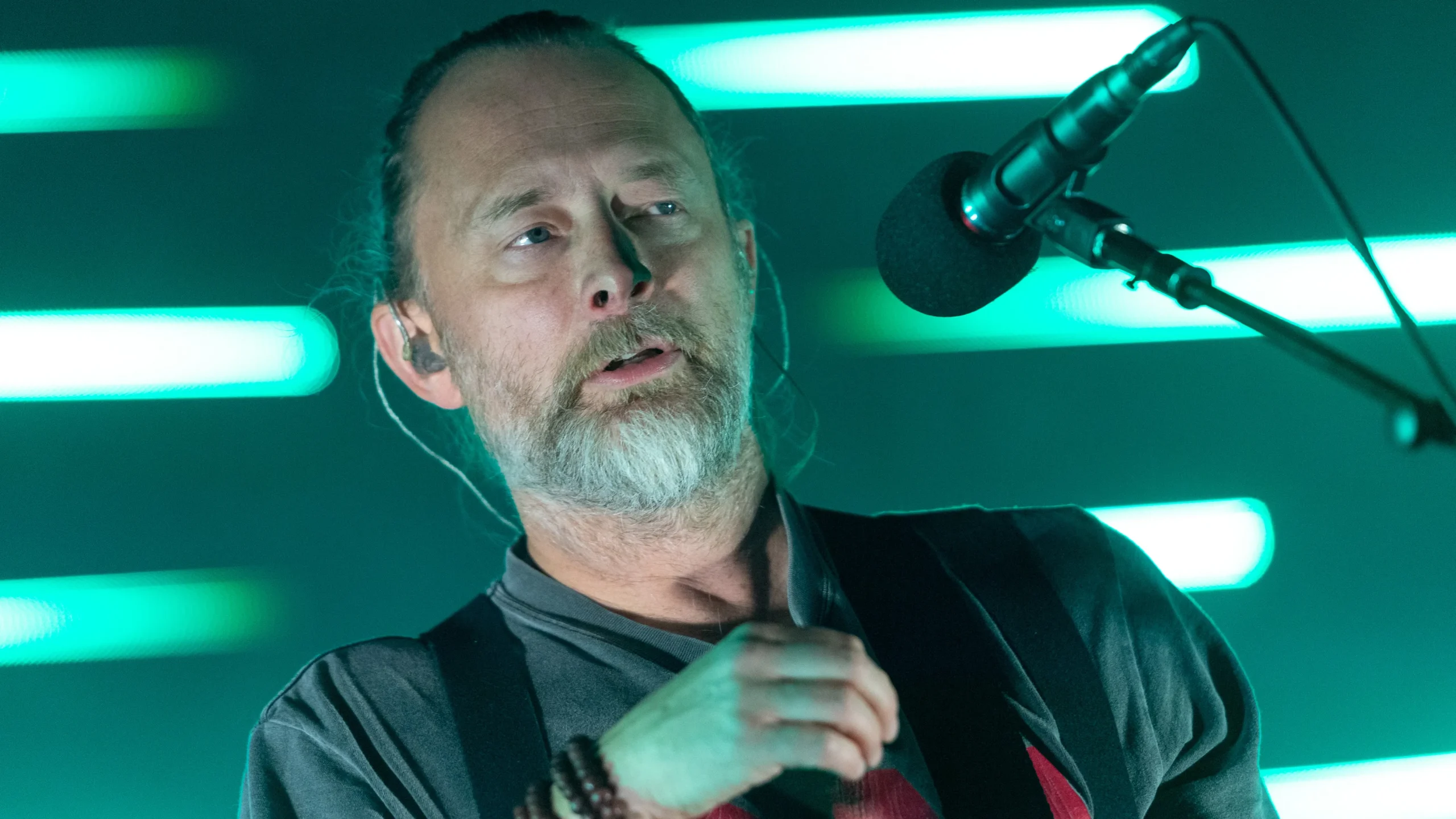
After months of mounting pressure and growing public frustration, Radiohead and The Smile frontman Thom Yorke has finally broken his silence on the war in Gaza. His statement, released following a tense confrontation at a Melbourne show and amid increasing demands from fans and fellow artists for accountability, attempts to walk a delicate line: denouncing violence on both sides, while also distancing himself from the more radical calls for cultural boycott.
Yorke condemned both the Israeli government under Benjamin Netanyahu and Hamas, describing the situation as “horrific” and labeling Netanyahu’s government “totally out of control.” He voiced outrage at the humanitarian blockade of Gaza and criticized Hamas for hiding behind the suffering of its own people. At face value, it’s a reasonable, evenhanded take—one that many Western artists lean on when navigating politically explosive territory.
But what’s missing here is context. Power imbalance. Urgency. Acknowledgment of the sheer scale of destruction Gaza has endured—tens of thousands killed, including thousands of children, entire neighborhoods reduced to rubble, and an ongoing humanitarian catastrophe that experts have called genocidal. For months, artists, activists, and fans have called on Yorke—not as a politician, but as a cultural figure with global influence—to take a moral stance, especially given Radiohead’s controversial decision to perform in Tel Aviv in 2017, defying the cultural boycott movement.
Instead, what we got was a familiar hedging of bets: condemnation of “both sides,” concern about social media polarization, and a vague appeal to shared humanity. But for many in the Palestinian solidarity movement, this kind of neutrality feels like complicity. When one side is the occupier and the other is occupied, when one has jets and tanks and the other has nowhere safe to run, calling for “balance” can feel like erasure.
To be fair, Yorke is not a politician, nor has he ever claimed to be one. But artists of his stature don’t get to feign detachment when their silence speaks volumes—and when their platforms have the power to shift global awareness. Cultural boycott isn’t just about optics. It’s about pressure. It’s about standing with those who have no voice, no shield, and no safe stage to speak from.
What makes Yorke’s statement sting even more is the timing. It came only after public confrontation—after being called out at a show. It reads as reactive, not principled. A box ticked, not a line drawn.
Meanwhile, his own bandmate Ed O’Brien has already spoken clearly and courageously, calling for an immediate ceasefire and for hostages to be released. Others in the global music community—from Killer Mike to Lowkey to the countless underground and indie acts refusing to perform in complicit spaces—have taken louder, riskier, and more unequivocal stances.
To be clear: it’s not about demanding perfection. It’s about demanding clarity. When you’ve benefitted from a global stage, the very least you can do is use it when it matters most. Palestinians don’t need poetic metaphors or philosophical musings. They need solidarity. They need artists willing to name the violence for what it is—and call for it to stop.
Thom Yorke may have broken his silence, but in a moment of such urgent crisis, what he didn’t say is still louder than what he did.