
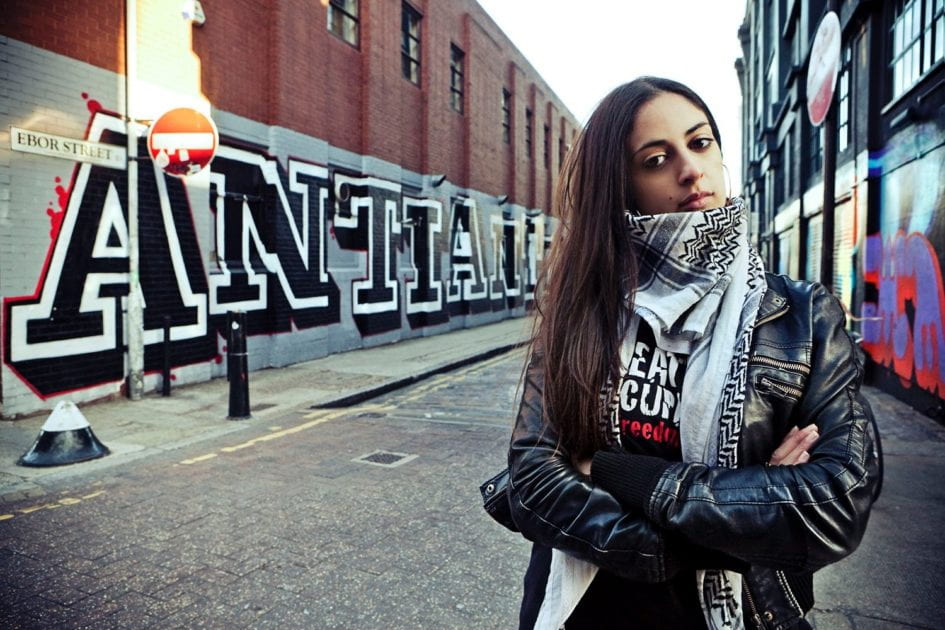
Shadia Mansour doesn’t just rap about Palestine—she embodies it.
Dubbed the “First Lady of Arabic Hip-Hop,” the British-Palestinian artist has been using her voice to challenge Zionism, U.S. imperialism, and Arab silence since she first stepped to the mic. At a time when most artists are still finding the courage to speak up about Gaza, Shadia Mansour has spent her entire career doing just that—and she’s never looked back.
Born Into Resistance
Shadia was raised in London to a family of Palestinian and Yemeni heritage. Her parents were singers, and she grew up surrounded by the melodies of Arabic classics and the weight of political exile.
But it wasn’t just music. It was memory.
It was loss turned into language.
“They may take our land, but they will never take our voice.”
— Shadia Mansour
Fluent in both Arabic and English, she raps and sings across the spectrum—blending classical Arab music with boom-bap beats, and delivering politically charged rhymes that cut through censorship like glass.
Fashion and the Flag
Mansour is known not only for her lyrics but for what she wears: the keffiyeh.
Not as an accessory.
As armor.
On stage, she often wears traditional Palestinian dress and wraps herself in the black-and-white scarf synonymous with resistance. Every performance becomes a political act, every lyric a reclamation of land, language, and life.
Anthems for the Occupied
Her most iconic track, “Al Kufiyyeh Arabiyyeh” (The Keffiyeh is Arab), featuring Iraqi-British rapper Lowkey, is a global anthem of Palestinian pride and Arab resistance. The chorus echoes like a battle cry:
“The keffiyeh is Arabic—don’t let them steal it.”
The track doesn’t just celebrate culture. It reclaims it from fashion houses, from settler propaganda, from Western erasure.
Global Movement, Grassroots Voice
While Shadia may not get the same mainstream Western spotlight as other artists, she’s revered across the Middle East and among diasporic youth as a pillar of resistance culture. She performs at protests, refugee camps, universities, and community fundraisers—not red carpets.
She’s collaborated with revolutionary voices like Lowkey, DAM, and Narcy.
She’s refused to perform in spaces that normalize Israeli apartheid.
And she’s called out Arab regimes for their complicity and cowardice in the face of Palestinian suffering.
Shadia isn’t just an artist.
She’s a firestarter.
Why Exposed Vocals Stands With Her
Shadia Mansour has been doing this before hashtags.
Before ceasefire letters.
Before the mainstream realized silence is no longer acceptable.
At Exposed Vocals, we salute her for laying the groundwork—with every lyric, every stage, every song.
She is the soundtrack of resistance.
She is the blueprint.