Sandro Morales-Santoro on Scoring Horror Without a Picture
Exposed Vocals • Interview
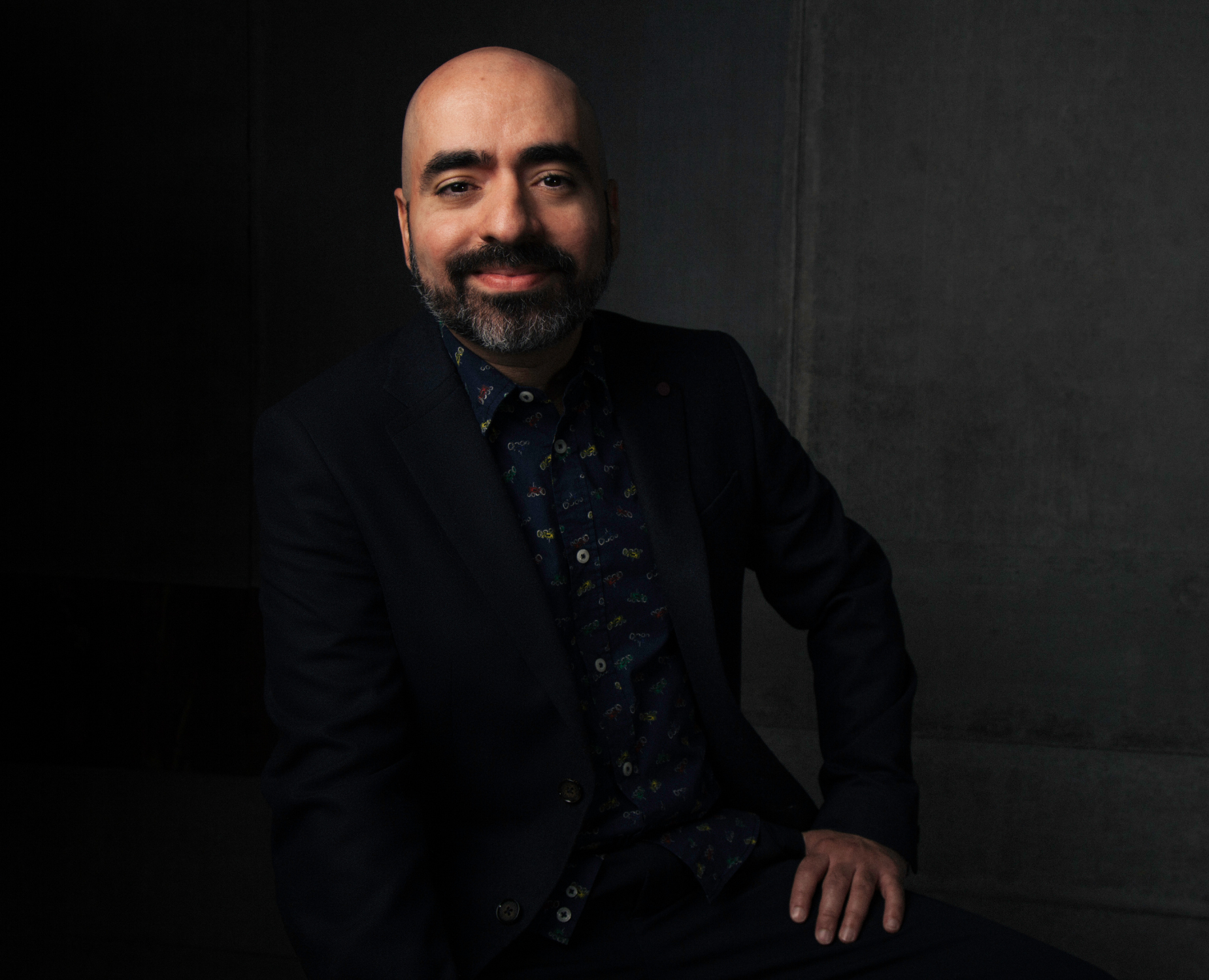
Sandro Morales-Santoro begins with the story. For his work on the audio horror anthology The Strange Thing About…, the Venezuelan composer reads the script before listening to performances or sound design, imagining the textures and melodies that might bring its world to life.
In this conversation, Morales-Santoro explains how dialogue and sound provide dramatic landmarks, why silence matters in a headphone mix, and how Venezuelan rhythms, live orchestras and a growing trust in simplicity shape his work.
EV: When there is no picture to score against, what becomes your first anchor for building tension: the script, the voice performance, the sound design, or something else?
Sandro Morales-Santoro: I love storytelling, so I'm always drawn to the story first. I like to read the script before hearing any performances or sound design, and try to imagine the story's soundtrack as I picture it in my mind: the different colors, textures and melodies that would best accompany the world described on the page. Specifically for horror, the voice performances and the sound design are crucial for knowing where to bring and amplify tension, but my preference is to have a clear idea of the piece's sonic landscape before then.
EV: How do you create suspense in an audio drama without relying on the visual timing cues a film composer normally has?
Sandro Morales-Santoro: Dialogue and sound design are a great guide. They give me hit points and dramatic changes, similar to how an edit would. But there's also much more freedom and space for the music to take over and move the audience one way or another, which is also a big responsibility. I'm happy to work with a writer/director as brilliant as Eric Sherman on this project, because communication between us is key to make sure the music is doing its job dramatically.
EV: Does The Strange Thing About… have a recurring musical identity across episodes, or do you treat each story as its own world?
Sandro Morales-Santoro: I treat each episode as its own world. That being said, my voice as a composer, the use of live orchestra and Eric's creative sensibilities are the thread that keeps these scores sounding cohesive, with similar intentions and colors.
EV: How do you decide where orchestral writing ends and electronic texture begins in this series?
Sandro Morales-Santoro: I think it depends on the episode. Some episodes focus more on love and emotion, and those tend to have very little, if any, electronic texture. It's mostly orchestral colors for the key scenes, and even lighter scoring is done with acoustic instruments. In horror-driven episodes, however, I tend to use those electronic colors as the main tool for building tension and hitting those jump scares.
EV: What role do silence and negative space play in a horror score built for headphones?
Sandro Morales-Santoro: I think the absence of sound can be as terrifying as any score. And pulling the sound right before something happens is a very effective tool in horror, because the absence is noticeable in a way it wouldn't be in a theater. On headphones you’re right inside the mix, so when the music drops out you hear the room, the breathing, and every small sound becomes a threat.
EV: How closely do you work with the director, actors and sound-design team before the final cue structure takes shape?
Sandro Morales-Santoro: Working closely with Eric is essential, to get the tone right and help steer the audience where he intended as the writer of the story. That is my number one priority. After that, I don't communicate much with the actors; I just react to their work and the nuances of their performances. Regarding sound design, I usually receive the episode when the sound design track is nearly final, which helps me plan around it and complement it where necessary. And whenever I've needed more sonic space for the music, or anything adjusted to fit the key of the score, the sound design team has always been amazing collaborators and graciously helped make it work.
EV: How has growing up in Venezuela shaped the way you hear rhythm, melody or dramatic space in your work?
Sandro Morales-Santoro: I think Venezuelans are very connected to and open about their emotions; they are very raw and visceral about what they feel. That connection to what's inside, which is part of our traditions and artistic expressions, has found its way into my approach to scoring drama, instinctively going for the gut punch, in emotion and equally in horror and tension, and then relying on my experience as a film composer to dial back and reel in those feelings where needed. Rhythmically and melodically, I'm influenced by Venezuelan traditional music, and it shows up in my scores in ways that aren't obvious but that I think are part of my voice. The shifting 6/8 and 3/4 feel of joropo, that constant pull of three against two, is something I use all the time.
EV: Across Shadow of the Sun, ParaGold and Vela, which musical idea best shows how your approach has evolved?
Sandro Morales-Santoro: Not being afraid of simplicity. That's the single most important thing I've learned over the years, and it is evident in those projects. I used to worry too much about the musical complexity of my scores, but once I stopped thinking about that and focused my energy on emotion, I found a freedom that, I believe, has made my music more effective and, I hope, can connect at a deeper level with audiences. In these three projects you can hear simple melodies and chord changes, most of them reiterated throughout each film as an emotional anchor for the story.
EV: Are there particular instruments, recording techniques or pieces of technology that have become signatures in your current workflow?
Sandro Morales-Santoro: What I love most about my job is recording with an orchestra. It gives me immense freedom to create the themes, textures and drive needed for any story. I play piano, percussion and some stringed instruments including guitar, ronroco, charango and Venezuelan cuatro, implementing them into my scores where appropriate. I enjoy working with woodwinds, especially the alto and bass flute. I love working with analog synthesizers like the OB-6, the Moog Sub 37 and Roland’s Juno-6, and modular synths are a great way to find unique sounds and textures.
EV: What should listeners pay attention to the next time they hear one of your scores, and what are you most interested in exploring next?
Sandro Morales-Santoro: I hope listeners will be moved. That's my number one goal. I hope they pay attention to what they're feeling when they hear any of my scores, especially my work for The Strange Thing About… season finale, where the score takes the audience on a literal trip across space and time, with help from the Budapest Scoring Orchestra. Next, I want to work more on video games; that's a medium that I find very interesting because it allows for an extended and detailed storytelling experience.
Morales-Santoro says he hopes listeners pay attention to what the score makes them feel. His next creative interest is video-game music, a medium he describes as offering an extended storytelling experience.
Signal this interview
Send it up if it hit, down if it missed. The most engaged pieces surface on Signal.
Keep reading
Back to Interviews ↗
From this section
Orthodox Tactics on NOT FOR SALE, Conscience and the Cost of Belonging
October 28, 2026
From this section
Arcylo on Choose You, an Alien Identity and the Human Heart Behind It
October 28, 2026
From this section