Monk’s Temple Records began with a group of “psychedelically-inclined oddballs” in Boston who did not see themselves in the traditional label pipeline. Nearly four years later, founder Brandon Armstrong—also known as Gasoline Monk—still treats that outsider position as the label’s organizing principle: build mythology, reward sustained attention and create a community where the relationship between artist and audience is not rented from a platform.
That philosophy now reaches from open studio days and project-based master ownership to a direct-to-consumer ecosystem built after automated distribution moderation nearly derailed No AI Was Used, Armstrong’s new album with Terry Borderline. Below, Armstrong explains why Monk’s Temple wants “the weirdos,” how its artist-first model works and what the label is building beyond Spotify, DistroKid and the quick-hit economy.
Brandon Armstrong: The Exposed Vocals Interview
What did you want Monk’s Temple Records to solve that you were not seeing in the traditional label model?
When we started it, we were just a bunch of psychedelically-inclined oddballs in Boston who didn’t really fit comfortably into the existing pipeline. That was the impetus – let’s be stronger together. But a north star for us has been building mythology, and trying to reorient listeners back to a deeper experience, rather than emphasizing the short-attention-span economy of social media and single floods. We’ve been doing this almost four years and that has been sort of the tone we grow under and make decisions around.
You describe Monk’s Temple as both a label and a community. What does that combination look like in practice for an artist?
Everybody at the Temple shows or listening to Temple music at home IS the Temple. It’s an open door world – if you feel like you belong, you do. It also means for us organizers that our events aren’t always just “showcases” or “concerts”. We do a lot of open mics for the community. We throw a lot of parties that are supposed to feel just like that – a party you’re at with your friends. For an artist, usually your introduction to working with Monk’s Temple comes on one of our all day studio sessions, where we may have a dozen artists coming in and out throughout the day.
Karim’s a good example. Karim started out just coming and getting in where he fit in – and it evolved naturally into vocal coaching other people in the studio – and now we just released DON’T FEED THE PILGRIMS, a full length album that we worked on for a year. But these things didn’t come from a business meeting where we “pitched ourselves” – they came from showing up at the studio and sort of making your place there.
What tells you an artist or project is the right fit for the label?
We’re basically vetting people on those open studio days. No pressure – if they aren’t clicking for more long term work, no problem, still great to have you. What we look for (beyond just talent that we’re obsessed with) is a couple things.
First, work ethic. Fanta Vibez and I are just super hard-working and aren’t going to go far with somebody who isn’t. Discipline beats raw talent.
The second thing is a sort of fearlessness to follow your own vision, not coming at music in a calculated way. We want the weirdos!
How do ownership, creative control and long-term development work inside your artist-first model?
All the master recordings we produce, the artist owns equally. We co-own those masters and profit equally from them and both take on the marathon work of creating, packaging and promoting them. We also don’t sign artists – we sign projects. We’ll never tell an artist not to take a great opportunity for our sake. It’s our job to elevate artists to a place where those great opportunities are going to come more frequently.
The automated “Superhuman” flag became part of the story behind No AI Was Used. What did that experience reveal about today’s distribution systems?
What happened with No AI Was Used was a moment where I was like, okay, we’re not even dealing with human beings anymore, we can’t appeal to common sense. If we continue down this road we’re putting ourselves in a position where our careers could be derailed by algorithms. Fanta and I have had many talks about going direct-to-consumer. But after we went through that, I went on a rabid code binge and actually put the whole ecosystem together. It’ll be live by the time you publish this. And more and more of what we do going forward will only be available exclusively through us. Then, we own our relationship with our audience. We don’t rely on Spotify or DistroKid or Instagram and wouldn’t be left floating without a paddle if those companies fell.
Where does Monk’s Temple draw the line between useful creative technology and technology that replaces or obscures human authorship?
That’s a good question – Terry Borderline will be the first to tell you the point of No AI Was Used wasn’t just to hate on AI, but to raise conversations about it. I’m a software developer by trade and any software developer in 2026 knows that AI is inescapably part of the job. So there are plenty of times where AI is a tool in a toolkit and in fact that’s been the case for a long time. The real problem is generative AI, where artists are using it to shortcut the work of actually making art.
To me, I don’t even really understand the appeal of that. I don’t understand it as a musician, and I don’t understand it as a listener. I create music to discover things. I discover things about my own internal state, and the world around me, and I perform a sort of alchemy in transforming those abstract things into something concrete. As a listener, I’m listening for the same thing, on the other end – I want to hear the artist’s discovery, and undergo this empathetic experience of sort of temporarily seeing the world as they do. AI just doesn’t offer that in any way, shape or form.
For that reason I’m never scared of AI music beating out human music. If there are a lot of people who are cool listening to AI music, that’s really their loss, and they’re probably not the type who would accept our invitation to engage with music more deeply.
The album is expanding into a browser game and short film. Why is world-building important to the way you develop releases?
That’s a common thread amongst Temple artists, is that we’re having a lot of visions and all just get childlike wonder about them. And we create an ecosystem to just nerd out on those visions. Terry and I are both just the type to get giddy and excited when we start saying things like, “Ya, and what if we made a video game like Streets of Rage where we’re battling AI and like the agents from the matrix?!” It all comes back to trying to offer a deeper experience through music and get away from the quick hit economy that’s kind of the dominant tone in 2026.
What are the label’s biggest priorities over the next year, and what kinds of artists or collaborators would you most like to meet?
The biggest priority for us over the next year is really developing the DTC ecosystem that we’re creating. Make it a subscription model that we just overload with fun stuff and ways to connect on a more personal level with our tribe. Make it so the value we offer way exceeds the support we receive.
I don’t often think about like “dream collabs”. My dream collabs are Fanta Vibez, Terry Borderline, Karim, Reggie Hue, and Chi Sen$ei. Those are the five artists we’ve been working on albums with this year and it’s everything I need.
Monk’s Temple is betting that an independent label can become more durable by making itself more human: shared ownership, open rooms, deep-listening mythology and direct audience relationships. Armstrong’s answer to platform uncertainty is not withdrawal, but a fuller world—one artists and listeners can choose to enter together.
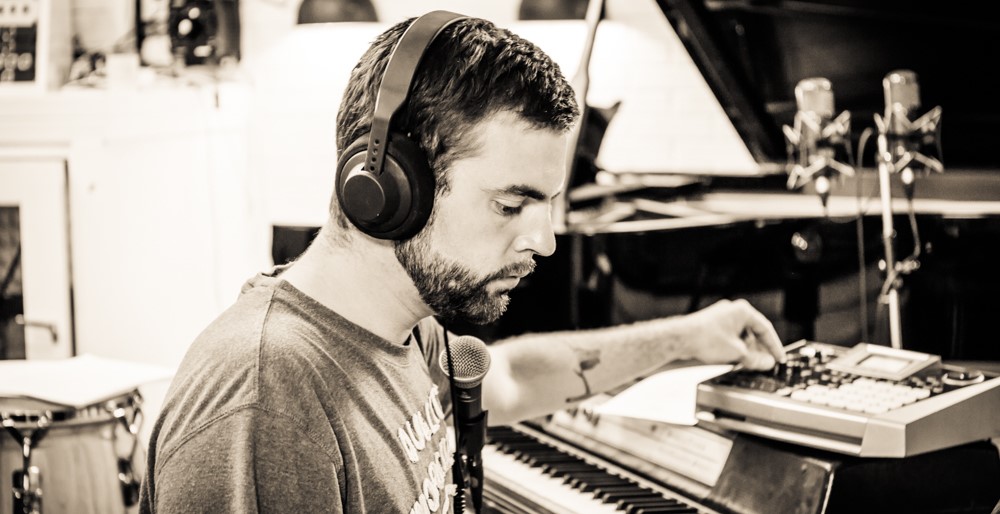
Brandon Armstrong, also known as Gasoline Monk, is the founder of Monk’s Temple Records. Featured image: Gasoline Monk in the studio. Photo by Boe Larsen; supplied by Monk’s Temple Records and used with permission.