
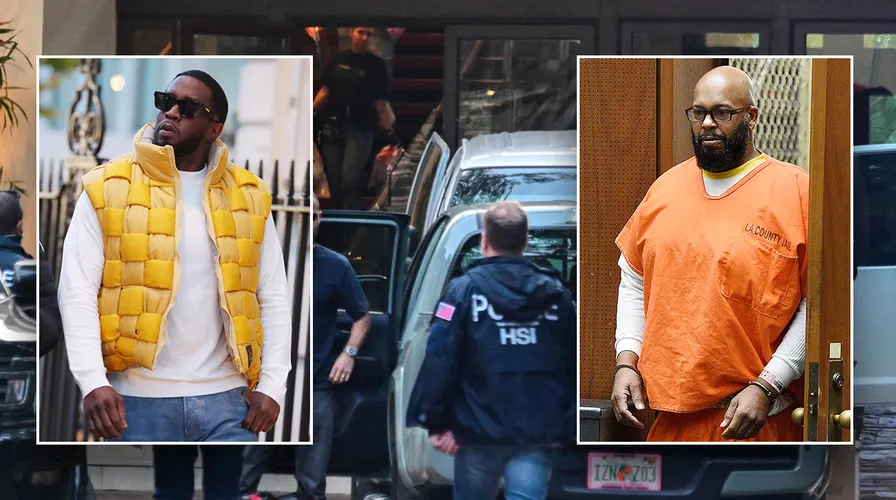
It was a surreal scene — and yet, somehow, perfectly fitting for the era we’re living in. On May 29, 2025, Marion “Suge” Knight, the once-feared mogul of Death Row Records, phoned into CNN from a California prison cell to offer his thoughts on the federal trial of his decades-long rival, Sean “Diddy” Combs.
There was no studio lighting. No entourage. Just the voice of a man behind bars, speaking calmly from a state prison, offering unsolicited counsel to another music titan now facing the possibility of dying in a cell himself.
“If he tells his truth, he really would walk.”
That was Suge’s message to Diddy — a simple line, layered with history, irony, and something resembling empathy. And it might be one of the most important public quotes in hip-hop this year.
Let’s be clear: Suge Knight and Diddy were never friends. Their feud defined an era. In the 1990s, Knight helped fuel the East Coast-West Coast rivalry that cost the lives of Tupac Shakur and The Notorious B.I.G. He was ruthless, theatrical, feared — and often accused of being everything wrong with hip-hop’s obsession with street mythos. Diddy, on the other hand, was flashier, more polished. He danced in suits while Knight prowled in red sweatshirts and sunglasses. They were power and paranoia in two very different packages.
So why is Suge speaking now? And why is he offering advice instead of taking shots?
Because this isn’t 1995. It’s 2025 — and both men are now cautionary tales.
Suge Knight is currently serving a 28-year sentence for voluntary manslaughter, stemming from a 2015 fatal hit-and-run in Compton. His legacy, once tied to groundbreaking artists like Tupac, Snoop Dogg, and Dr. Dre, now lives in podcasts and prison interviews. But make no mistake: Suge remains sharp, calculating, and undeniably influential. When he talks, people in the industry still listen — if only to make sense of how far things have fallen.
Calling into CNN’s Laura Coates Live, Suge offered more than just sympathy. He offered a worldview — one forged by prison walls, regret, and the long lens of reflection. He urged Diddy to testify, to humanize himself, to “tell his truth.” It was both ironic and poetic, coming from a man who has spent decades dodging accountability. Yet in that moment, Suge seemed to be doing what many powerful men never do: publicly acknowledging the cost of silence.
“Once you open that door and play with the devil, you’re going to become the devil,” Suge said during the call, in reference to the corrupting nature of power, money, and unchecked access in the music business.
And that’s what this story is really about.
For all its glitz, hip-hop has long had a power problem — not just in its lyrics or imagery, but in its boardrooms and backrooms. Power hoarded, weaponized, and abused. Whether it was Suge Knight allegedly dangling executives off balconies or Diddy now standing accused of coordinating sex trafficking rings and coercive abuse, the theme is the same: when unchecked power meets cultural worship, consequences get delayed, denied, or dismissed — until they don’t.
Suge’s call wasn’t just an odd news blip. It was a mirror. A man who had once been feared now reduced to a voice on a collect call, speaking to another man who once walked the red carpet with presidents and now walks into federal courtrooms in handcuffs. They’re not opposites anymore — they’re echoes of each other.
There was also a note of genuine concern. Suge, for all his theatrics, knows what it’s like to be isolated, to lose everything, to have your empire collapse while the world watches. He reminded viewers that “when a man has children, you’ve got to show sympathy.” It was an uncharacteristically human moment from a figure usually associated with menace.
It also raised a brutal question: Is Diddy the last of his kind, or just the latest to fall?
In the wake of more than 120 accusers coming forward, and with the federal trial still underway, Diddy is facing life-altering consequences. Whether he testifies or not may become the trial’s turning point. But what’s clear is this: Suge Knight’s voice — calling in from the margins — might be the most honest thing hip-hop has heard from its elders in years.
We’re in the middle of a reckoning. And sometimes, it takes a voice from the bottom of the barrel to remind everyone just how far the culture has drifted from its soul.
Editorial Note from Exposed Vocals
Suge Knight’s comments were made during a public broadcast and reflect his own opinions and life experience. While his remarks add valuable context to the Diddy trial and the state of power in hip-hop, it’s important to note that Sean “Diddy” Combs is presumed innocent until proven guilty in a court of law. Our coverage aims to balance critical analysis with fairness, integrity, and respect for the gravity of the charges at hand.