Pussy Riot and the New Russian “Extremist Search” Law: When Protest Becomes a Crime
In this story
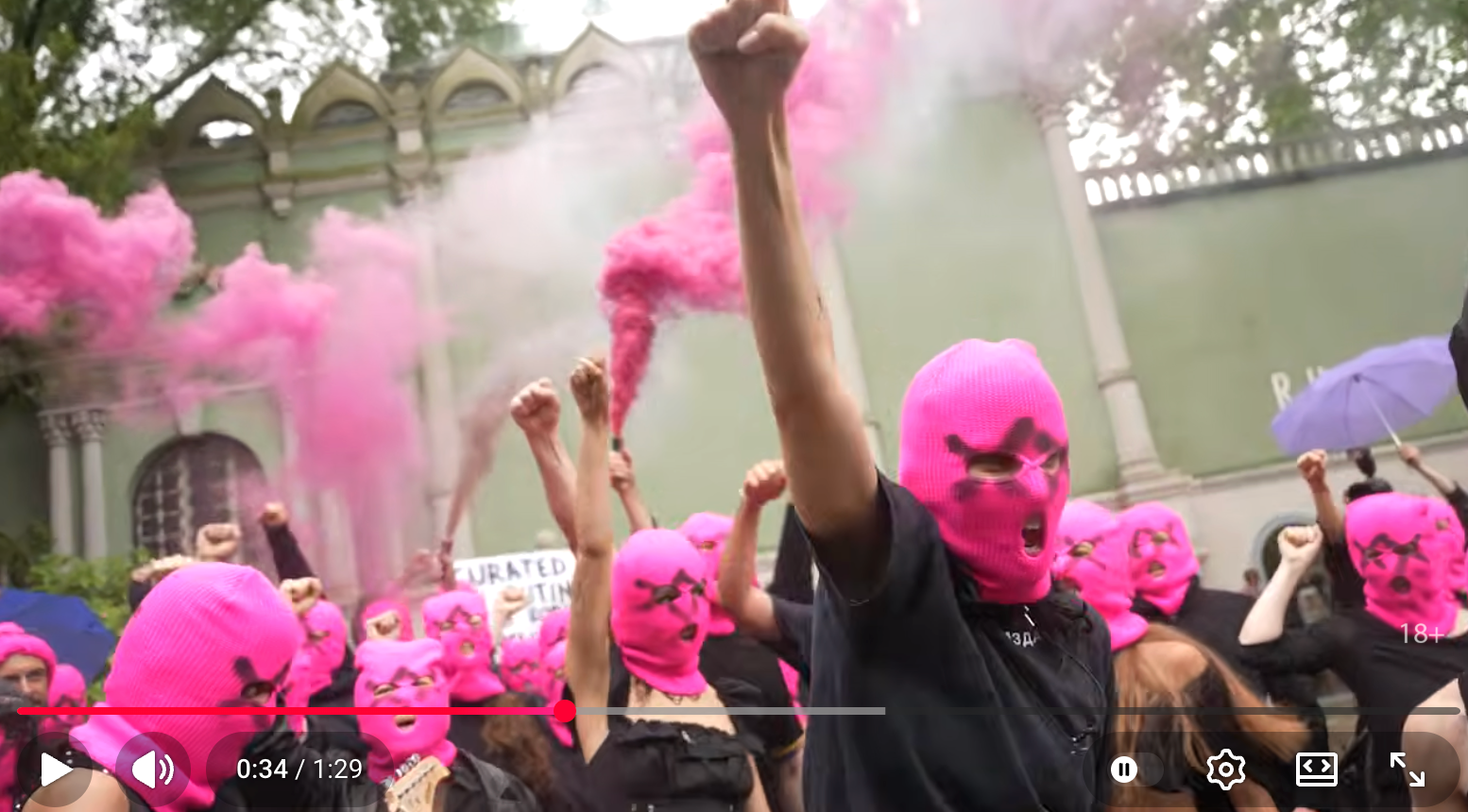
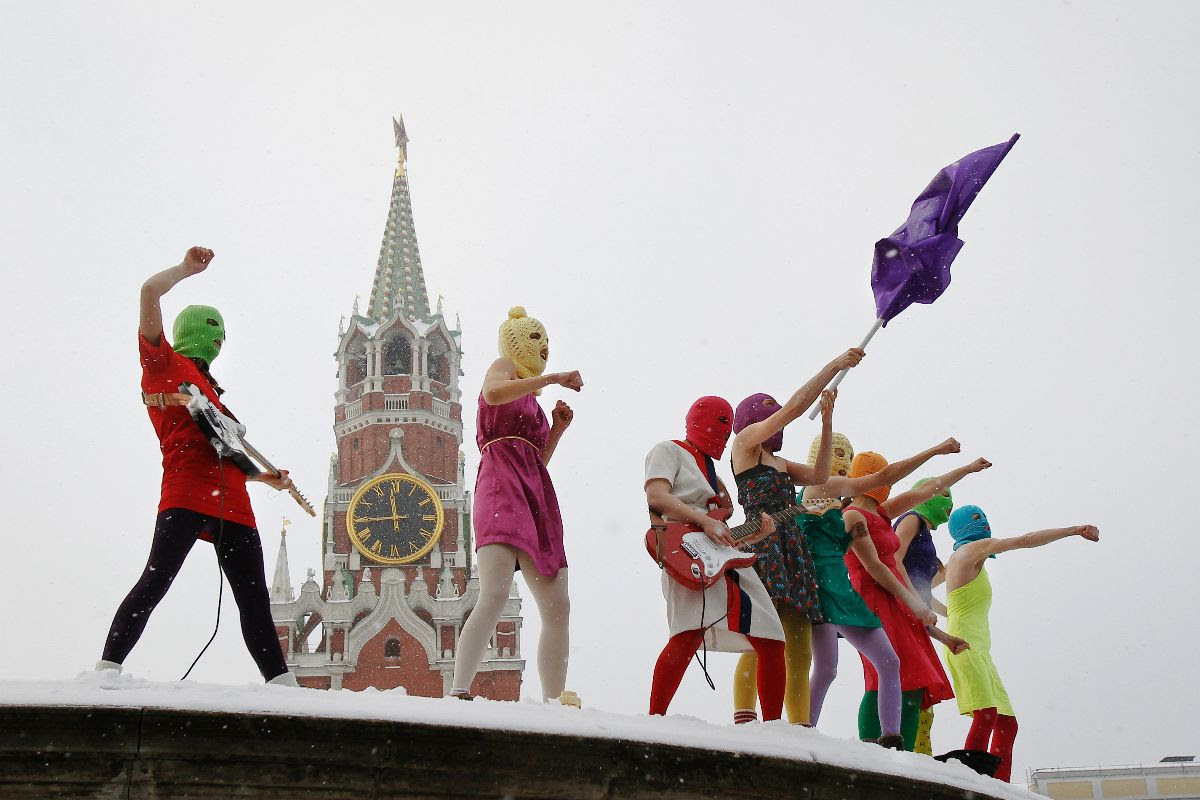
More than a decade after storming Moscow’s Cathedral of Christ the Savior with a burst of neon balaclavas and feedback-soaked guitars, Pussy Riot remain one of the most recognizable protest collectives in the world.
Formed in 2011 by artists including Nadya Tolokonnikova, Maria Alyokhina, and Yekaterina Samutsevich, the feminist punk group fused riot-grrrl ferocity with performance-art provocation.
Their guerilla shows—brief, unsanctioned, and defiantly political—railed against sexism, authoritarianism, and the close alliance between the Kremlin and the Russian Orthodox Church.
Their 2012 performance of “Punk Prayer: Mother of God, Drive Putin Away” led to arrests, trials broadcast worldwide, and two-year prison sentences that turned the collective into a global symbol of artistic dissent.
In the years since, Pussy Riot’s members have expanded beyond music into visual art, blockchain activism, and human-rights advocacy, using every available platform to campaign for political prisoners and gender equality.
Their sound—raw punk noise colliding with electronic protest anthems—has influenced a generation of artists who see no boundary between stage and street.
A New Crackdown on Digital Dissent
On July 17, 2025, Russia’s State Duma passed Article 13.53 of the Administrative Code, a new law that makes it an offense to intentionally search for or access online material appearing on the state’s Federal List of Extremist Materials.
That list, maintained by the Ministry of Justice, runs thousands of entries long and, according to multiple independent outlets, includes audiovisual recordings of Pussy Riot’s performances and related political content.
Beginning September 1, 2025, individuals who “knowingly search for or open extremist materials” online face administrative fines of 3,000 – 5,000 rubles (roughly US $55 – $60).
Organizations can be fined up to 100,000 rubles.
While the offense is technically civil rather than criminal, it extends the state’s ability to police private behavior on the internet in ways critics say are nearly impossible to enforce without mass surveillance.
Reuters reports that the law’s drafters framed it as a measure to “protect citizens from extremist propaganda.”
But human-rights observers argue that it effectively punishes curiosity and research, not advocacy or distribution.
The Ins (English edition) notes that the text criminalizes not only viewing but even searching for prohibited materials—a first for Russian legislation.
It also warns that tools “used to deliberately circumvent restrictions,” such as VPNs or proxy services, could themselves fall under related administrative penalties.
Why Pussy Riot Is Mentioned
Because some of Pussy Riot’s early videos are formally listed as “extremist” by the Ministry of Justice—a designation dating back to the 2010s—the new rule theoretically makes it illegal for Russian citizens to search for or stream those clips, even for journalistic or academic purposes.
That inclusion turns an act of political art into contraband and folds it into the same legal category as genuine hate propaganda.
For Tolokonnikova, now living abroad and recently sanctioned as a “foreign agent,” it’s another sign of how dissenting art is equated with extremism.
A Broader Pattern
Article 13.53 fits a wider pattern of tightening control over digital expression.
In recent years, Russian lawmakers have criminalized “discrediting the armed forces,” expanded the definition of “foreign agent,” and required social platforms to remove “unreliable information.”
Together, these measures have shrunk the space for protest music, independent journalism, and online debate.
Analysts note that the practical enforcement of the new rule remains uncertain: tracking individual search queries at scale would demand intrusive monitoring or compelled cooperation from service providers.
But its symbolic impact is clear—instilling caution among users, musicians, and researchers who might otherwise engage with banned material.
The Cultural Cost
For artists like Pussy Riot, whose work thrives on visibility, the new law reinforces exile as both a safety measure and a creative reality.
Their recent international collaborations—NFT fundraisers for Ukraine, pop-art installations on surveillance culture, and benefit tours for imprisoned activists—show that the message still travels even when access at home is blocked.
Yet within Russia, the effect is chilling: a generation raised on YouTube and Telegram now faces potential punishment for simply looking up its own counterculture.
Art, Protest, and Persistence
Pussy Riot have always insisted that art can outlast repression.
From prison memoirs to global stage performances, they’ve turned punishment into performance, documenting the cost of speaking freely.
Article 13.53 may attempt to bury their history under the label of “extremism,” but it also proves their point: that a song, a scream, or a flash of color in a cathedral can still frighten power.
Sources: Reuters (July 22 2025), The Ins (July 18 2025), Consequence (July 23 2025), TASS (July 17 2025).
Keep reading
Back to Music News ↗
From this section
Manu Grace Turns Misadventure Into Agency on “Oh Man, I’ve Done It Again?”
October 23, 2026
From this section
Frank Vasquez Turns Survival Into the Seven-Song Still Here
October 20, 2026
From this section