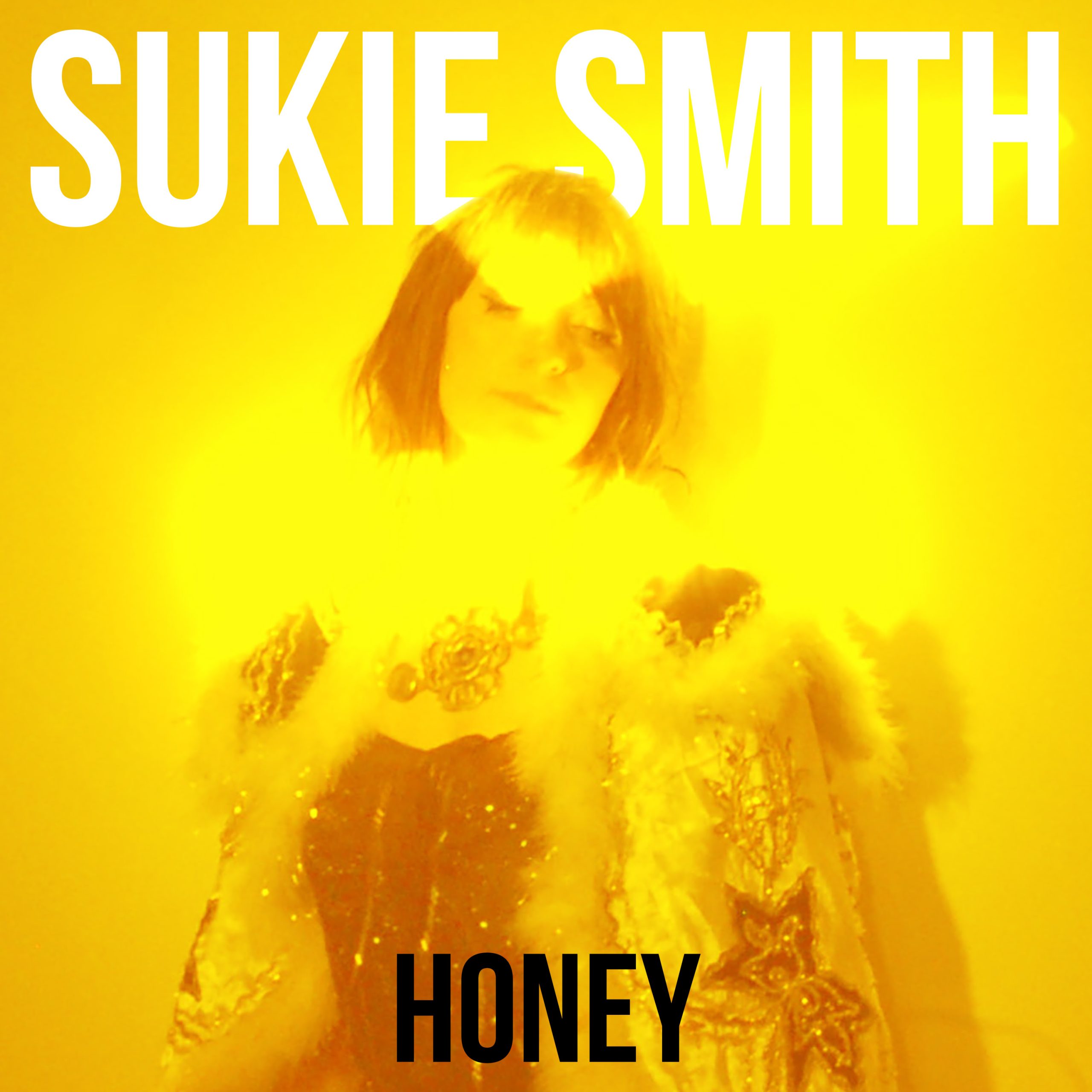
Following the release of her mesmerizing new single “Honey”, Exposed Vocals sat down with the visionary artist Sukie Smith to explore the surreal experiences behind the music, the making of her upcoming album The Glass Dress and a Ringing Bell, and how creativity becomes a lifeline when everything else falls away.
Exposed Vocals: “Honey” is incredibly vivid and personal — can you share more about the experience that inspired it?
Sukie Smith:
Thank you — I so love the word vivid. I’m replying to these questions in the upstairs room of a big old house on the Kent coast, while a huge storm batters the building. The sounds of the wind and the violent splats of rain on the windows feel very appropriate when I think about the environment of this song.
A few years ago, before COVID, I went for a routine operation that was supposed to be just a few days’ recovery. But for various reasons, it became a dangerous and very perilous situation. I was transferred to different ICU wards in a morphine haze, wired up to machines to keep me alive. While my body was very sick and still, my mind disassociated from the physical battle the doctors were engaged in and became abstract. Sound, time, and place became twisted — I was in a twilight world of sensation and revelation.
It’s beautiful to realize that the more personal a song is, the more truly it connects with someone else. A song seems to be the best way to say the unsayable.
Exposed Vocals: What was it like creating music during such an intense period — both personally and globally?
Sukie Smith:
I think a lot of my art is made covertly — I fool myself into thinking I’m not writing or creating by using parts of my house not associated with creativity at all. So making an album during COVID was part of that.
The Glass Dress and a Ringing Bell had to be a solo record. It started to form as an idea during my long hospital recovery — shaped by the visions and questions I had as I returned to my physical self. It became clear to me that there’s such limited time to speak out loud.
I wanted to explore the difference between a band-based record and one that mainlines my interior cinematic, boundaryless soundscape. I went to a studio in London and began working with producer Nick Trepka. “Honey” was the first track we created, and it came together very quickly. Nick asked me about the essence of the experience, and I described the jettisoning through time and the return to reality I’d felt. He created that push-pull, epic sound that dominates the track.
It was so freeing — to speak in concepts and abstraction rather than count bars and time signatures. We worked as money allowed, then continued mixing over Zoom once COVID hit and Nick moved to Brighton.
Exposed Vocals: How did the collaboration with John Lee Bird on the video come about?
Sukie Smith:
John and I have been collaborating on shows and events for years. We met when he painted a portrait of me for his Before Encore series. He paints huge, glamorous, colorful portraits of underground artists — often just before they hit the mainstream. It’s an astonishing body of work.
He loved “Honey” and we talked about making something together. I went to his studio and we filmed through the night. He has such a brilliant sense of narrative — the film builds in intensity with the objects I interact with, ending in a beautiful burst of color. A proper journey.
I love working with John. We even went to L.A. for a show at the Pacific Design Center and lived in a condo in West Hollywood together. Dream life.
Exposed Vocals: You describe waking up from that moment as feeling changed. How has that transformation shaped the new album?
Sukie Smith:
It was an undeniable reckoning — I properly saw another side of existence: interdimensional, non-physical, wild, and deeply connected. It awakened a dazzling awareness of my interior life and stripped away the careful, speculative approach I had toward everything.
It reminded me of who I was as a child — all in. All the songs on the album were written post-survival, and they explore that transformation in different ways.
Exposed Vocals: What does the rest of the album explore in terms of sound and story?
Sukie Smith:
It’s an album of recovery, rebellion, and resurrection.
After the hospital, I perversely created another dangerous situation — perhaps to see if I could cheat destruction a second time. Lockdown only intensified it. Writing and recording this album helped me identify that trouble and create a blueprint for emancipation.
Exposed Vocals: How has your creative process evolved over the years?
Sukie Smith:
My songs are more complex structurally and lyrically now. I’m bolder in the studio — constructing sonic environments that truly house the song.
Recently, I’ve recorded tracks with Tricky, and witnessing his simplicity and speed has influenced me. He pulls songs out of nowhere in hours, while I usually take much longer. That contrast made me want to explore more instinctive creation.
I now plan to write the next set of songs on my own, with a home setup — laptop instead of acoustic guitar. I’ve also grown to enjoy collaborative songwriting, which I used to resist. It’s fascinating to see how ideas evolve with a collective mind.
My lyric writing is shifting too — from observational and journal-like to something more intentional, almost like a spell.
Exposed Vocals: Do you see visual art as a key part of your music expression?
Sukie Smith:
Yes — times one million.
I see songs. I have synesthesia, so there’s no leap between sound and image for me. I even had a podcast where I asked visual artists about the role music plays in their creative practice. Everything is everything.
I sort of hear pictures too. I don’t think I’ve ever said that to anyone before. The same with nature — nothing is passive.
Exposed Vocals: Who or what are your biggest inspirations right now — musical or otherwise?
Sukie Smith:
- Hilma af Klint
- John Galliano’s Spring 2009 shoe collection
- Charlotte Skene Catling
- The James Webb Space Telescope
- All canine beings
Exposed Vocals: What do you hope listeners feel when they experience “Honey”?
Sukie Smith:
Maybe they feel like someone else has experienced what they might have.
Music is that for me — the articulation of the unsayable, or even the not-yet consciously thought. It’s always a recognition.
Exposed Vocals: Where can fans best support you and follow your journey?
Sukie Smith:
I’m very private, but I love interaction. So any of the socials — Instagram, TikTok, Facebook — they all serve different purposes.
I also have a mailing list on my website where I share updates about music, acting, filmmaking, and journalism. It’s a direct link — no ticket agencies in the way.
And of course, the gorgeous Bandcamp. Every time someone buys something from me there, it feels so profound — like an acknowledgment of light in the dark.