
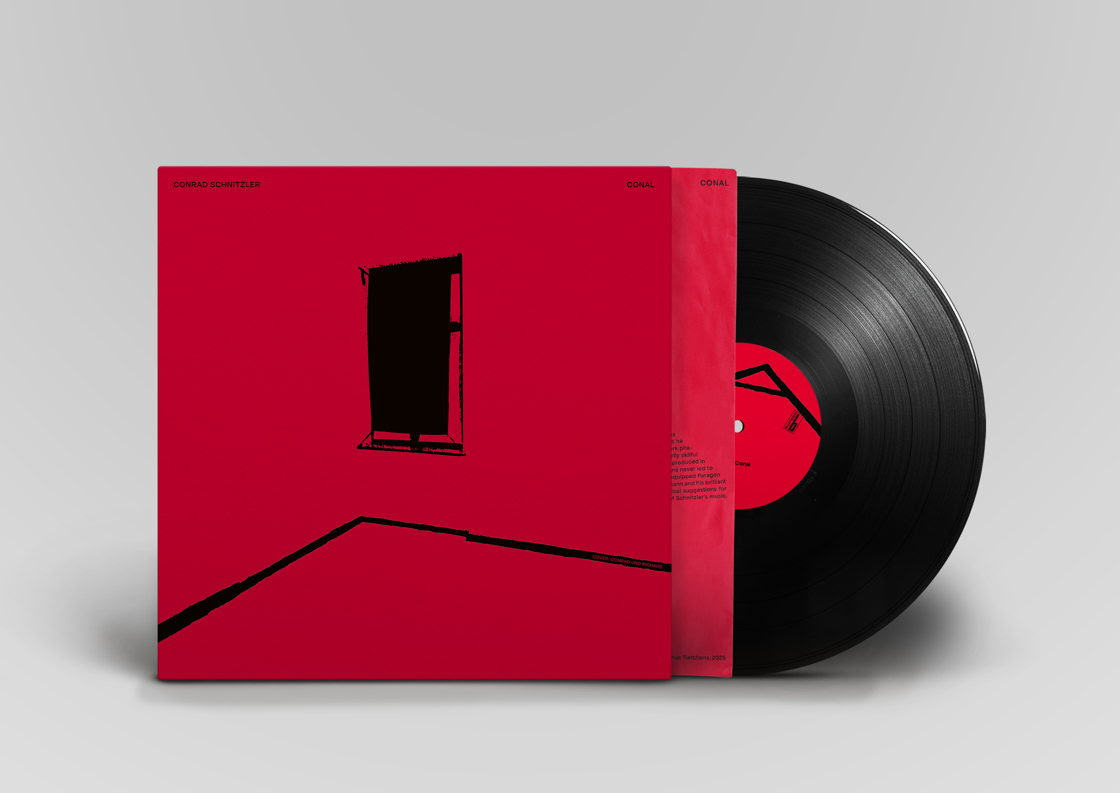
Bureau B announces the reissue of Conrad Schnitzler’s Conal, originally released in 1981 on Norway’s Uniton Records in a pressing of 4,000 LPs. It arrives July 10, 2026 on CD Digipak with an 8-page booklet and LP with printed inner sleeve — the first time the album has been widely available since its original run.
Schnitzler died in Berlin in 2011, but his catalogue — one of the most restless and uncompromising in the history of electronic music — has been steadily reclaimed through Bureau B’s ongoing reissue program. Conal is one of the stronger entries: two 21-minute pieces of rare compositional sophistication, likely recorded at Peter Baumann’s Paragon Studio, and representing a distinct creative step forward even by Schnitzler’s relentless standards.
When Conal was released, Schnitzler had already long been known beyond the borders of West Germany and was appreciated worldwide as a media artist and musician. It astonished his listeners in a positive way: once again, Schnitzler had dared to take an artistic step forward.
— Bureau B liner notesWho Conrad Schnitzler Was
Conrad Schnitzler (1937–2011) studied under Joseph Beuys at the Düsseldorf Kunstakademie, co-founded the Zodiak Free Arts Lab in West Berlin, played on Tangerine Dream’s debut Electronic Meditation (1970), and co-founded Kluster — the group that would later become Cluster — alongside Dieter Moebius and Hans-Joachim Roedelius. He left Kluster in 1971 and spent the following four decades producing solo work of almost unmanageable volume and range: cassettes, LPs, CD-Rs, and self-releases, distributed through a network of independent labels across Germany, Norway, the USA, Spain, and Japan.
He was not a musician who sought commercial footholds. He worked from a home studio in Dallgow, Germany, pursued what AllMusic described as an “influential but shadowy” presence in experimental and electronic music, and left behind an archive that has still not been fully excavated. Bureau B — the Hamburg label that has been the primary steward of his catalogue in recent years — estimates there are still significant gaps in what the wider listening public has access to.
The two tracks on Conal — “N1” and “N2,” each around 21 minutes — consist of several distinct parts blended together without credits. The sequence creates the character of a narrative divided into chapters, without offering the listener a concrete plot. Schnitzler was not a storyteller. He was something harder to name.
— Exposed VocalsWhat Conal Is
Conal stands out even within Schnitzler’s output for the sophistication of its structure. Where many of his albums unfold as sustained improvisational explorations — single-idea pieces built around synthesizer textures, drone, or rhythmic pattern — the two sides of Conal are composite works: multiple distinct sections crossfaded and layered together without being credited as such in the original sleeve notes. The result is something that moves like a cinematic narrative without providing a story, a panoramic view of Schnitzler’s work in condensed form.
The technical execution points toward Peter Baumann’s Paragon Studio as the likely recording location. Baumann — a former Tangerine Dream member who built one of the best-equipped studios in Germany — repeatedly made the facility available to Schnitzler despite the two never formally collaborating musically. The crossfades and layering on Conal have an unusually flawless quality that suggests access to proper studio resources. Baumann’s engineer Will Roper may have contributed technical suggestions as well.
The album title follows Schnitzler’s well-known practice of beginning almost all his LP titles with the syllable “Con” — Con, Rot, Blau, Control, Consequenz, Convex — but the second syllable “al” resists obvious interpretation. Bureau B notes candidly that they don’t know how Schnitzler arrived at it. The mystery feels appropriate.
The grand mosaic that is Schnitzler still has gaps, even when the contours are clearly visible. How many other treasures are waiting to be rediscovered?
— Bureau BWhy This Reissue Matters
Schnitzler’s influence on the architecture of electronic music is foundational — his work runs beneath Tangerine Dream, Cluster, and the broader Berlin School, and his methodological approach to synthesis and composition anticipated ambient, industrial, and contemporary experimental practice by years. Yet outside of specialist circles his name remains less known than his former collaborators, partly because so much of his output was released in tiny editions through small labels and self-distributed cassettes.
Bureau B’s ongoing program of reissues — which has also addressed Con, Convex, Consequenz III, Conditions of the Gas Giant, and others — is the most systematic attempt yet to make his catalogue genuinely accessible. Conal arrives July 10 on LP and CD Digipak. For anyone tracing the lineage of electronic music from Stockhausen through the Berlin School and into the present, this is not background listening. It is primary source material.
Conrad Schnitzler’s Conal is reissued July 10, 2026 on Bureau B. LP and CD Digipak available through bureau-b.com.