
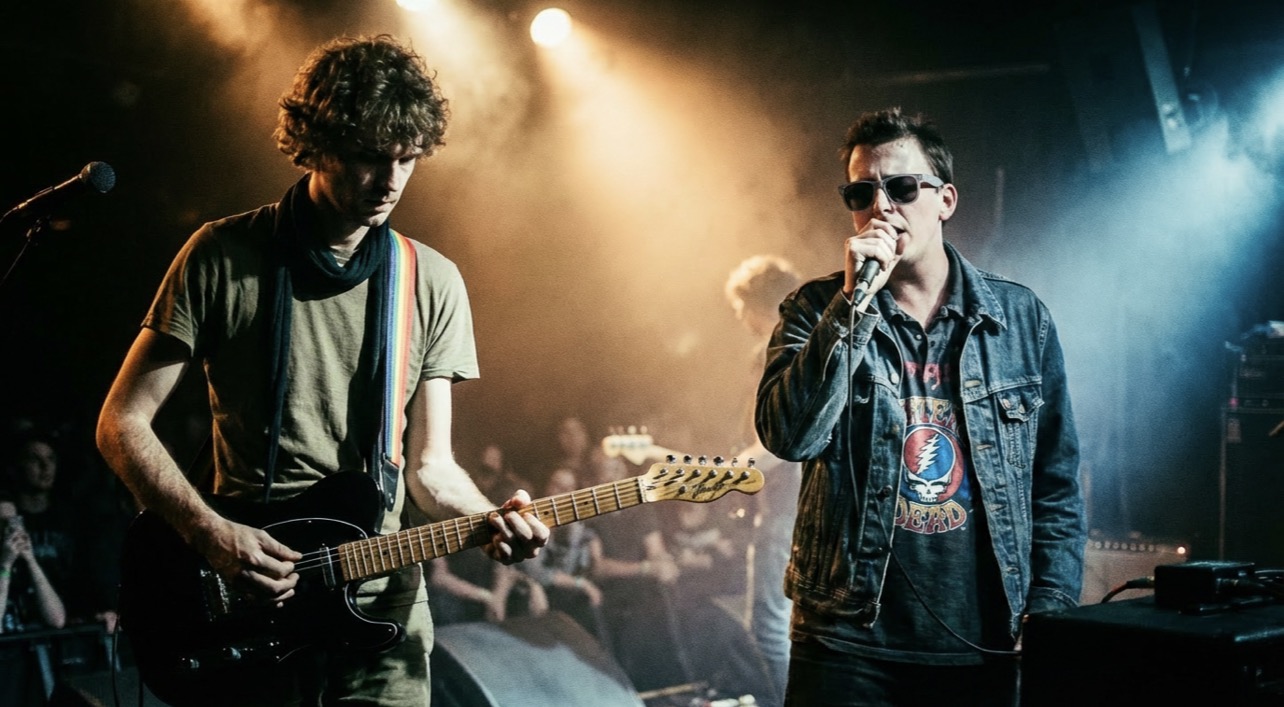
Cassius Wolf and Don Watson met at school in Liverpool at age 11, worked together at Eric’s — the legendary club that incubated Echo & the Bunnymen, OMD, and The Teardrop Explodes — and formed Cassius Wolf & Das Abs in 1978. They wrote the songs that make up their debut album in 1981. That album, An Afternoon in Bedlam, is out now.
The path between 1981 and 2026 runs through Tascam Portastudio cassette archives, careful restoration, and contemporary production tools applied in service of the original spirit rather than against it. Lead single “Losing Sleep” — melodic, guitar-driven, obsession-shaped — is the clearest entry point. The album is wider than that, and worth the full listen.
An Afternoon in Bedlam refers to the practice in the Victorian era of visiting the asylum for entertainment. The parallel with social media today — the appetite for division, outrage, and public spectacle — reflects a darker side of human nature. The themes of 1981 feel uncomfortably at home in 2026.
— Cassius WolfEric’s, 1978 — and What Came After
Eric’s Club on Mathew Street in Liverpool was one of the defining venues of the post-punk era — the room where Echo & the Bunnymen, OMD, The Teardrop Explodes, and a dozen other bands of lasting consequence found their footing. Cassius Wolf and Don Watson were there, not as observers but as participants, absorbing the city’s particular brew of punk attitude, reggae cross-pollination, melodic experimentation, and independent creative spirit.
They formed Das Abs in 1978 and spent years developing material in private, Cassius recording on a Tascam Portastudio with the kind of obsessive focus that only works when there’s no audience to disappoint. The cassettes accumulated. Life moved on. The material waited. Decades later, with those archives carefully restored and reworked using contemporary production tools, An Afternoon in Bedlam delivers those 1981 songs to an audience for the first time — not as nostalgia, but as a live document of ideas that never stopped being relevant.
“Losing Sleep” lands somewhere between urgency and emotional consumption — the state where someone lodges in your head until thought and feeling start to blur. It draws deep from the northern post-punk lineage: The Wild Swans, the melodic instinct of Paul Simpson and Ian Broudie.
— Exposed VocalsAn Afternoon in Bedlam — The Album
“Losing Sleep” is the lead single and the most accessible entry point — guitar-driven, melodic, rooted in the early post-punk pop instinct that ran alongside the more angular side of the scene. The Wild Swans, The Lightning Seeds, the melodic northern strain that never got as much credit as the darker Manchester lineage. It captures the particular texture of obsession: the person who occupies more mental real estate than they’ve earned, the fixation that refuses rational terms.
The album moves through a wider emotional and sonic landscape from there. “I Can’t Reply” channels communication breakdown through throbbing basslines and urgent guitar. “The Sound of the Guns” — co-written with Liverpool musician John McGlone of Western Promise — expands into punk-reggae territory, a direct anti-war statement carrying the spirit of The Clash and Steel Pulse. “Controls To Extremes” leans into UK roots reggae and dub textures. “Tell Me” brings atmospheric uncertainty, longing balanced against emotional distance. The Cure and Depeche Mode haunt the darker romantic edges; Can and The Velvet Underground show up in the experimental corners.
Built from restored analogue recordings and shaped by the “PCore” philosophy the duo describe — a movement celebrating artists who continue pursuing creative ambitions later in life — An Afternoon in Bedlam is proof that some music simply needed time to find its moment.
They were there when it all began — at Eric’s, in 1978, at the exact center of the Liverpool post-punk scene that shaped a generation of bands. An Afternoon in Bedlam is the record they were always going to make. It just took 45 years to arrive.
— Exposed VocalsWhy It Matters Now
The Bedlam conceit — Victorian asylum tourism as a mirror for the modern internet’s appetite for outrage and public suffering — isn’t a clever press hook. It’s a genuine thematic foundation that gives the album coherence across its range. Songs about fractured relationships, emotional paralysis, alienation, and control aren’t abstract here; they’re specific observations from people who watched the post-punk era grapple with the same questions and are watching the present do it again, louder and faster.
For listeners who came up on the Liverpool scene or the broader British post-punk moment, An Afternoon in Bedlam will feel like finding a record that should have existed all along. For listeners coming to it fresh, it’s a reminder that the energy of that era — the urgency, the melodic precision, the political instinct — didn’t go anywhere. It just went underground. “Losing Sleep” is streaming now. The full album is out on all platforms.
An Afternoon in Bedlam is out now. Stream it from the top, with “Losing Sleep” as the door in.