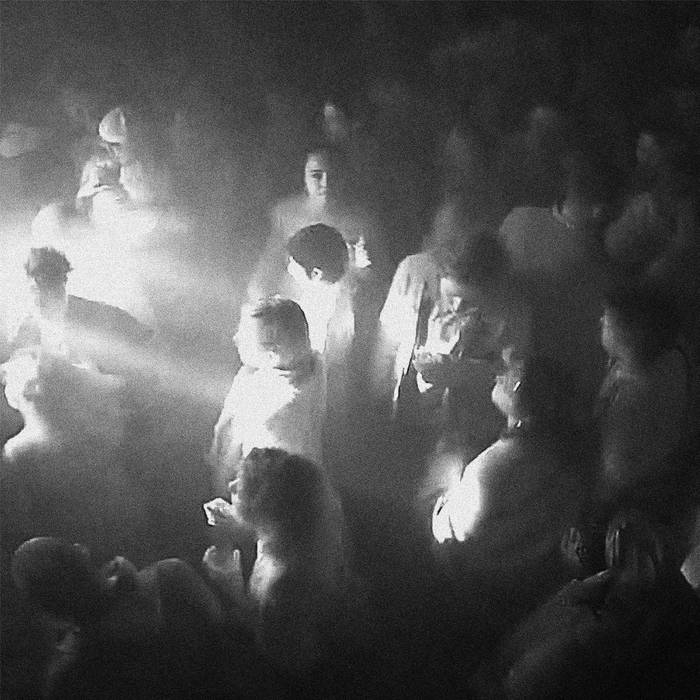
At just 22, feeo introduced herself as an old soul with the weight of the world in her voice. Now, four years and several haunting releases later, her debut full-length Goodness delivers on the quiet promise she’s been crafting all along—a record that leans deeper into abstraction, yet feels more intimate than ever.
From the opening moments of Goodness, we are no longer merely listening—we’re falling into feeo’s disintegrating dreamscape. “Days pt. 1” doesn’t even feature her singing; instead, her father, veteran actor Trevor Laird, narrates a surreal meditation on chaos, loss, and the absurd cruelty of the universe. Over scorched feedback and spectral textures, the song lands like a warning: This is not comfort music.
But that’s the genius of feeo. She’s never handed us clarity. Instead, she lingers in ambiguity—her voice a spectral thread weaving through sparse arrangements that often sound more like dust settling than music playing. Across Goodness, her production grows more minimalist and abstract, yet her storytelling becomes mythic in scale. On “The Mountain,” she sings of a whale as if it’s both god and beast, capable of destroying and birthing worlds. It’s not a metaphor; it’s a reckoning.
Still, Goodness isn’t about spectacle—it’s about sensation. “Requiem” and “Win!” feel like secret thoughts caught on tape, her voice flickering between speech, sigh, and song. The production—sometimes built from little more than manipulated vocal samples—feels like it’s decaying in real time. Horns wheeze like memories, guitar lines crumble at the edges, and synths glisten like rainwater over ruins.
The centerpiece, “Here,” is nothing short of astonishing. Clocking in at over seven minutes, it drifts between Grouper-like haze and folk-inflected despair. It’s a song about staying too long in a place that takes too much from you. feeo sings of London as a graveyard of ambition, where people “count minutes like lost loose change,” and yet she clings to the hope of escape. “I say it all the time,” she pleads. It’s a heartbreakingly human moment—one that sits at the heart of Goodness: the push and pull between surrender and survival.
If Goodness has a narrative arc, it’s one of philosophical inquiry. Both “Days pt. 1” and “Days pt. 2” bookend the album with Trevor Laird’s gravelly musings—first despairing, then darkly humorous—as if even cosmic tragedy can be laughed at if you squint hard enough. It’s this tonal sleight of hand that makes feeo so singular. Her music is fragile but never weak, experimental but emotionally grounded, bleak yet shot through with sharp glimmers of humor and hope.
The closing track, “There Is No I,” feels like the softest answer to all the album’s swirling questions. Accompanied by weeping slide guitar and little else, feeo sings, “We’re better together” like a benediction. It’s the most straightforward moment on the record, but also the most affecting—a whispered thesis that love, not despair, might be what lingers longest.
With Goodness, feeo hasn’t just arrived—she’s rewritten the map entirely. This is a debut album that sounds like a final statement, only to leave us certain she’s just getting started.
RIYL: Beth Gibbons, Grouper, Tirzah, Jenny Hval, Loraine James
Standout Tracks: “Here,” “Requiem,” “There Is No I,” “Win!”
Signal this review
Send it up if it hit, down if it missed. The most engaged pieces surface on Signal.