From Medellín to MetLife: How Karol G Became a Global Bichota
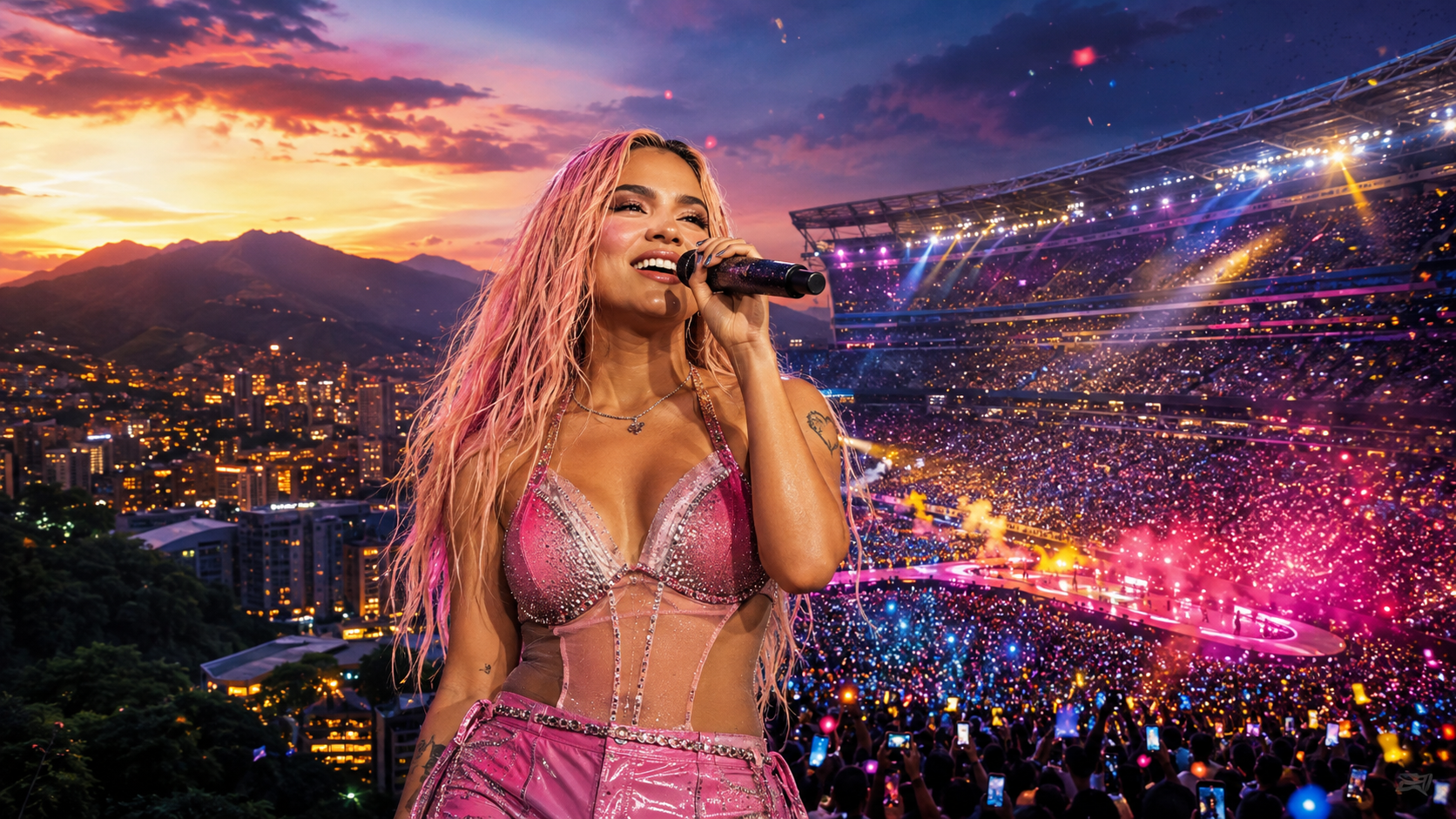
Before the Grammys, billion-stream anthems and sold-out stadiums, Carolina Giraldo was a teenager from Medellín being told that reggaetón did not have room for a woman like her. Karol G answered by making the room bigger.
Karol G’s career is often described through records: firsts, number ones, billions of views, millions of tickets. The more important story is what came before the numbers—the years when almost nobody in power could see what she already knew.
On September 17, 2026, Karol G will stand at the center of MetLife Stadium in East Rutherford, New Jersey. The building can hold the scale of an NFL game, a global spectacle or a generation-defining concert. That night it will hold a Colombian woman whose earliest ambitions were repeatedly treated as unrealistic because the music she loved was considered a man’s territory.
There is a clean version of that journey: talent show, record deal, breakthrough, superstardom. The real journey was not clean. It required years of small stages, doors closing, strategy changing, confidence breaking and being rebuilt. It required Karol G to become more than an interpreter of songs. She had to become the author of her own scale.
That is why MetLife matters. It is not merely another stop on the Viajando Por El Mundo Tropitour. It is physical proof that the people who once believed there was no market for a woman in reggaetón misunderstood both the artist and the audience waiting for her.
01. Before Karol G, There Was Carolina
Medellín, Colombia • The beginningCarolina Giraldo Navarro was born and raised in Medellín, surrounded by a family that treated music as something worth pursuing rather than a fantasy to outgrow. She sang young, studied music and appeared as a teenager on Colombia’s version of The X Factor. The television exposure did not instantly create a star. It did, however, make an internal conviction public: this was not a passing interest. Carolina intended to build a life in music.
Her father, Guillermo Giraldo, became a central ally. The family invested time, money and belief when the safer response would have been to encourage a more conventional future. They visited stations, pursued opportunities and supported performances wherever an audience could be found. That foundation matters because the mythology of the self-made superstar can erase the quieter people who keep a dream alive before the world agrees that it has value.
She adopted the name Karol G and began releasing music, but a name does not dissolve an industry’s assumptions. Urbano and reggaetón were expanding rapidly, while women were still routinely treated as guests in a male-led ecosystem. Karol G has recounted flying to Miami for an industry meeting and being turned away with the message that a woman performing reggaetón would not work.
That rejection now sounds absurd because her success has changed the evidence. At the time, it was an institutional judgment delivered to a young artist who did not yet possess the numbers to refute it.
The revolutionary part of Karol G’s story is not that she never heard “no.” It is that she kept working long enough to make “no” look historically foolish.Exposed Vocals
02. The Years Between the Dream and the Proof
Persistence before recognitionLong careers are often compressed until struggle becomes a sentence between two successes. Karol G’s middle years deserve more than that. She recorded, performed in clubs and colleges, collaborated, promoted herself and tried to understand why momentum refused to arrive at the speed of her ambition. At one point she moved to New York and studied the music business, looking for knowledge that could help her navigate a system talent alone had not opened.
Those years shaped the artist the stadium audience now recognizes. She learned how songs move through radio and clubs, how image can amplify identity or distort it, and how persistence must eventually become decision-making. Waiting to be selected was not enough. She needed collaborators who understood her sound and a team prepared to build around her rather than treat her as an exception.
The breakthrough finally came into focus in 2017. “Ahora Me Llama,” her collaboration with Bad Bunny, placed her voice inside the emerging Latin trap conversation without making her feel secondary to it. The track carried independence as both subject and posture. Her debut album, Unstoppable, turned a decade of preparation into a public introduction whose title sounded less like branding than a summary.
Winning Best New Artist at the 2018 Latin Grammys gave the rise an official milestone, but “new” was almost misleading. Karol G had spent more than a decade becoming ready for the moment when the world finally began paying attention.
03. “Tusa” Makes Heartbreak Global
2019 • The crossover without compromise“Tusa,” featuring Nicki Minaj, became the kind of song that escapes ordinary measurements. Its title refers to the particular ache that follows heartbreak—a Colombian expression that did not need to be flattened into English to become internationally understood. The record was glossy, immediate and feminine without treating femininity as softness. Karol G turned emotional recovery into a communal event.
Nicki Minaj’s opening verse created an English-language entry point, but Karol G remained the song’s emotional center. That balance is important. The collaboration expanded the audience without suggesting that Spanish needed permission from English to occupy global pop.
“Tusa” traveled through clubs, cars, parties, radio, social media and bedrooms. Its success helped establish a principle that now appears obvious: listeners do not need every lyric translated before they can understand feeling, melody, confidence and release.
04. “Bichota” Becomes an Identity
Confidence as authorshipThen came “Bichota.” The word existed before the song, but Karol G reworked its masculine, street-coded power into a distinctly feminine declaration. In her use, a bichota is not waiting to be approved, rescued or placed beside a more important man. She understands her value and moves accordingly.
The concept connected because it offered more than luxury imagery or attitude. It gave listeners a role they could inhabit. Fans did not only sing the word; they used it to name the version of themselves that survived the breakup, started the business, walked into the room or chose confidence after being taught to minimize it.
She Did Not Enter the Boys’ Club. She Outgrew It.
Karol G’s impact cannot be reduced to the fact that she succeeded in a male-dominated genre. That framing still places the men at the center and defines her as the exception. Her deeper achievement was helping move the center itself. She made enormous, emotionally direct urbano music from a woman’s point of view and demonstrated that women were not a niche within the audience—they were an audience powerful enough to remake the market.
Her songs could be wounded without becoming powerless, sexual without surrendering agency, romantic without pretending love never failed, and triumphant without hiding what the triumph cost. “Bichota” became the shorthand, but the identity was constructed across an entire catalog.
05. Mañana Será Bonito Changes the Record Book
2023 • Vulnerability at stadium scaleMañana Será Bonito translated to “tomorrow will be beautiful,” but the album did not offer optimism as a cheap slogan. It moved through the unstable period between pain and recovery—the days when a person can understand that life will improve without yet feeling improved. That emotional honesty gave the album intimacy even as its commercial scale became historic.
In March 2023, the album debuted at number one on the Billboard 200, making Karol G the first woman to reach the top of that chart with an all-Spanish-language album. Later that year it won Album of the Year and Best Urban Music Album at the Latin Grammys. At the 2024 Grammys, it won Best Música Urbana Album, giving Karol G her first Grammy Award and making her the first woman to win that category.
Records can sound remote until we consider what they overturn. Years earlier, an executive’s reasoning had been that a woman in reggaetón was not commercially viable. Now a deeply personal Spanish-language album by that same woman sat above every other album in the United States.
“Provenza” captured the era’s open-air release: relaxed, sensual and seemingly weightless, yet supported by the control of an artist who knew precisely how she wanted freedom to sound. “TQG,” her collaboration with Shakira, brought two Colombian superstars together on a song about refusing to remain emotionally subordinate to men who had moved on. The collaboration felt culturally larger than gossip because it placed two generations of Colombian global pop power in the same frame.
The tour proved that those achievements were not confined to streaming accounts or awards rooms. According to Billboard Boxscore, the 2023–24 Mañana Será Bonito Tour grossed $313.3 million and sold 2.3 million tickets across 65 shows. It moved from U.S. stadiums through Latin America and Europe, concluding with four sold-out nights at Madrid’s Santiago Bernabéu Stadium.
The scale was extraordinary, but the emotional design of the show mattered just as much. Stadiums can make artists appear distant. Karol G’s challenge was to make tens of thousands of people feel as though they were participating in the same recovery story. Pink hair, animated worlds, handwritten sentiments, bright color and collective singing turned the production into something between a pop epic and a shared diary.
06. Tropicoqueta: Success Turns Back Toward Home
2025–2026 • Latin America as the destinationAfter a record-breaking era, the predictable move would have been to repeat its most successful formulas. Tropicoqueta looked in a broader direction. The 2025 album draws from a spectrum of Latin sounds and visual traditions—merengue, cumbia, vallenato, bachata, mambo, reggaetón and pop—without presenting them as museum pieces. It is colorful, theatrical and rooted in the idea that Latin music is not one rhythm or one country.
“Si Antes Te Hubiera Conocido” led that expansion with merengue brightness; “Papasito” pushed bilingual flirtation through a techno-merengue pulse. Elsewhere, the album gives regional forms modern pop framing while keeping their cultural character visible. Karol G was no longer only proving that a Colombian woman could dominate urbano. She was using global attention to celebrate the vastness of the musical world that produced her.
That distinction matters. Crossover once implied leaving home behind to become legible somewhere else. Karol G’s version of global success increasingly brings the audience toward home: toward Spanish, toward Medellín, toward Caribbean and Latin American rhythms, toward references that do not pause to explain themselves.
The Viajando Por El Mundo Tropitour takes that idea literally. Announced after her 2026 Coachella headline performances, the itinerary spans stadiums across North America, Latin America and Europe into 2027. It is not a victory lap for Mañana Será Bonito. It is a new production built for a more expansive musical identity.
07. September 17: Medellín Arrives at MetLife
East Rutherford, New Jersey • 7:00 PMMetLife Stadium is where scale becomes visible before the first note. Tens of thousands move across parking lots and train platforms, flags appear over shoulders, outfits become declarations, and private attachment turns into public community. For Karol G, the venue is an appropriate stop because her career has repeatedly transformed experiences treated as personal—rejection, heartbreak, rebuilding, pride—into something enormous enough for a stadium to share.
Karol G at MetLife Stadium
Elena Rose makes the pairing especially fitting. The Venezuelan American singer-songwriter built substantial influence behind the scenes, writing for artists across Latin pop before fully stepping forward as a performer herself. A stadium night headlined by Karol G and opened by Elena Rose is not simply two names on a bill. It reflects a wider movement in which women are increasingly visible as writers, decision-makers and architects of the music—not ornaments added after its direction has already been chosen.
There will be spectacle: color, choreography, costume changes, enormous screens and songs designed to detonate in a crowd. But the real spectacle is the distance traveled. A teenager from Medellín entered a television competition in 2006. A young artist spent the next decade hearing versions of why her ambition did not fit. In 2026, one of the largest stadiums in the United States needs two nights for her audience.
That does not happen because an industry generously opens a door. It happens because an artist keeps building pressure on the other side until the door no longer matters.
08. This Time, I Will Be in the Crowd
A personal note from Exposed VocalsI will be at MetLife on September 17.
When you marry a Colombian woman, you learn that music is never merely background noise. It carries cities, families, memories, humor and pride. And in my household, there is also a very practical rule: when Shakira or Karol G comes to town, you make arrangements.
That line makes me laugh because it is true, but the reason for going is larger than marital self-preservation. Watching an artist like Karol G in this moment means watching Colombian culture arrive without apology at American stadium scale. It means seeing thousands of people—many of them immigrants or children of immigrants—hear Spanish rising from the biggest stage in the building and understand that nothing about their identity had to be reduced to get there.
I expect my wife will understand details in the music, language and cultural references that reach her differently than they reach me. That is part of the beauty of attending together. We do not have to receive every song in exactly the same way to share the night. Great popular music creates that kind of bridge: specific enough to belong somewhere, powerful enough to invite everyone else across.
Karol G’s career also speaks directly to the independent artists Exposed Vocals was built to support. The lesson is not that everyone who persists will eventually fill MetLife. That would be dishonest. The lesson is that early rejection is often evidence of an institution’s limited imagination, not an artist’s limited potential. Development takes longer than a press release. Identity becomes powerful when it is refined rather than surrendered. And the people who believe before the metrics appear may be helping preserve something the wider culture will later call inevitable.
On September 17, the lights will go down at MetLife and the dream that once seemed too large will fill the entire building. My Colombian wife will be beside me, Elena Rose will help open the night, and Karol G will stand where the industry’s old assumptions can finally be seen for what they were: far too small for her.Randy Morano • Exposed Vocals
Keep reading
Back to The Grind ↗
From this section
Beyond the Directory: ROSTR’s Expansion and the Rise of Algorithmic Music Industry Networking
October 10, 2026
From this section
The Grind: Build a Fan Ladder That Gives Listeners a Next Step
October 9, 2026
From this section