From the Underground to the Sphere: How Metallica Became Immortal
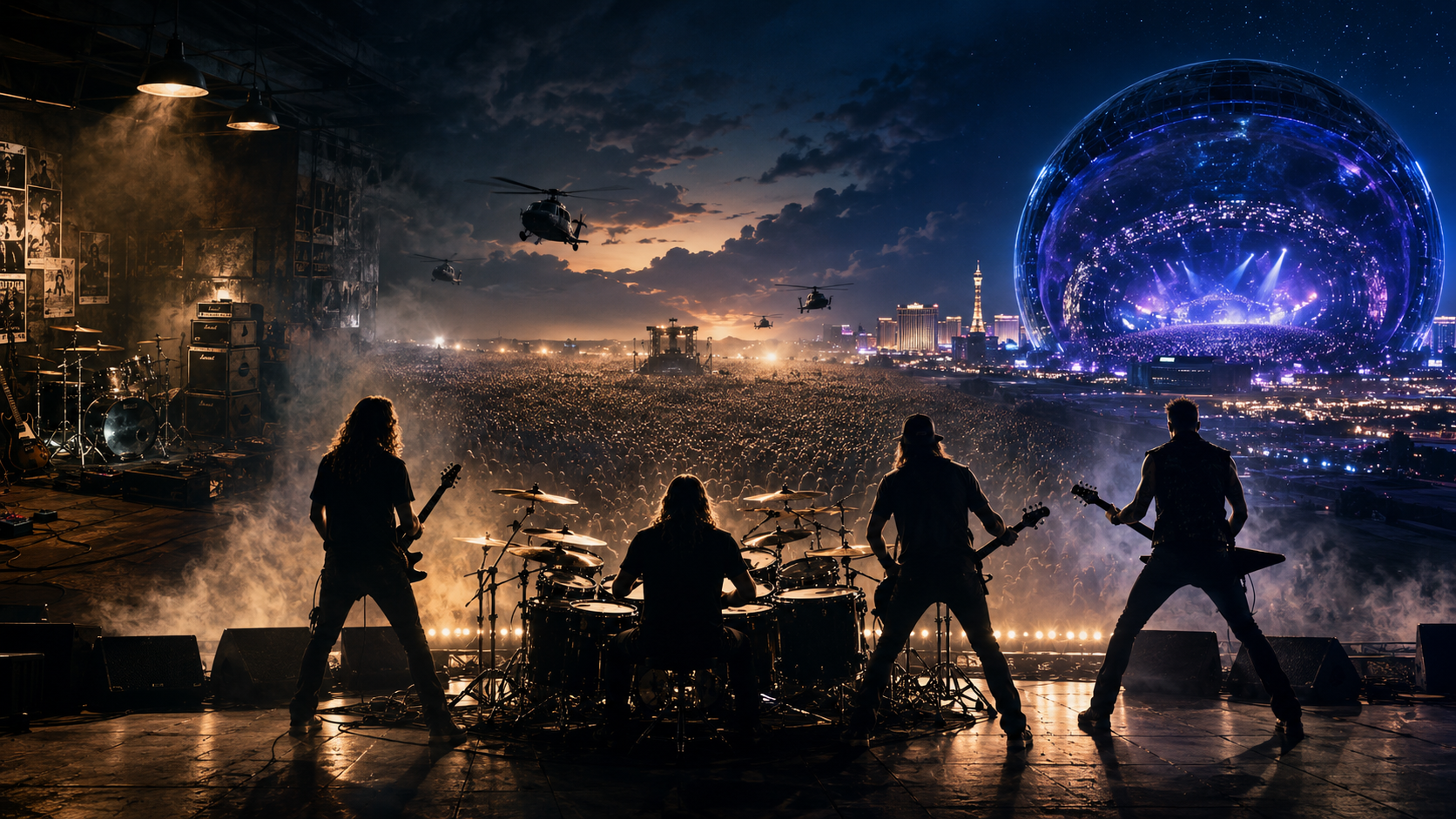
From an L.A. classified ad and underground tape trading to Moscow, stadiums and the most technologically ambitious stage on Earth, Metallica did more than survive its own legend. The band kept making it larger.
Most bands are fortunate to define an era. Metallica has outlived several of them—without becoming a museum piece, without surrendering the stage and without ever learning how to think small.
On Halloween night in Las Vegas, four musicians will walk into a building that looks less like a concert venue than an object dropped from the future. Around them, the highest-resolution LED display of its kind will climb over the audience. Sound will move through the room with a degree of control conventional arenas were never built to achieve. Thousands of people will have crossed states, countries and oceans to be there.
That would be an extraordinary destination for any band. For Metallica, it feels like the latest point on a line that began 45 years earlier with a newspaper advertisement, a borrowed name, traded cassette tapes and the absolute conviction that heavy music did not need permission.
This is not simply a story about longevity. Plenty of artists remain active. Metallica remains consequential. The band can release new material without treating it as an excuse to tour the old songs, fill stadiums with several generations at once and make a 1986 composition surge back through popular culture decades later. Now it is preparing to translate that weight, speed and scale into Sphere.
Metallica did not spend 45 years protecting a frozen version of itself. It became immortal by repeatedly putting that version at risk.
01. A Classified Ad and a Refusal to Wait
Los Angeles • 1981Metallica began on October 28, 1981, after drummer Lars Ulrich and guitarist-singer James Hetfield connected through Ulrich’s advertisement in The Recycler. Ron McGovney joined on bass, Dave Mustaine on lead guitar, and the band adopted a name suggested by Bay Area metal-scene figure Ron Quintana. The details sound almost modest now. Nothing about the music that followed was.
The early engine was the underground itself. Metallica’s No Life ’Til Leather demo moved through the tape-trading network, carrying the band farther than radio programmers or label executives had any intention of taking it. Fans duplicated it, mailed it and passed it to other fans. Before Metallica had a mass-media machine, it had belief traveling hand to hand.
The band moved toward the Bay Area after recruiting Cliff Burton, whose bass playing and musical intelligence helped expand its ambitions. Dave Mustaine was replaced by Kirk Hammett shortly before the recording of Kill ’Em All, released by Megaforce Records in 1983. The debut sounded fast, feral and gloriously uninterested in behaving. Ride the Lightning arrived a year later with greater melodic reach, darker storytelling and evidence that this supposedly primitive new metal could also be intricate, emotional and cinematic.
By Master of Puppets, Metallica had found the combination that would change the scale of metal: precision without sterility, complexity without losing physical force, and songs long enough to build worlds but memorable enough to live inside listeners. The band had not softened its identity to reach a bigger audience. It had made the audience come toward it.
02. Triumph, Tragedy and the Decision to Continue
1986–1990Then came the kind of loss that can end a band regardless of its momentum. On September 27, 1986, Metallica’s tour bus crashed in Sweden, killing Cliff Burton. He was 24. Burton had not merely occupied the bass position; he had helped widen the band’s musical vocabulary and shaped its internal chemistry.
There was no clean way forward. There was only the decision to have one.
Jason Newsted joined after an extensive audition process. …And Justice for All followed in 1988—dense, severe and structurally enormous. “One” gave Metallica its first music video, but even that breakthrough came on the band’s terms: a black-and-white nightmare built around war, mutilation and isolation. The song became a bridge between the underground institution Metallica already was and the global phenomenon it was about to become.
Metallica’s defining talent was never just playing heavy music. It was making heaviness carry grief, fear, anger, politics and ambition without collapsing under the load.Exposed Vocals
03. The Black Album Opens the World
1991The self-titled album released in August 1991—known everywhere as The Black Album—changed the dimensions of Metallica’s career. Working with producer Bob Rock, the band traded some of the labyrinthine structures of Justice for a sound that was more focused, heavier in a different way and impossible to keep outside the mainstream.
“Enter Sandman” had the architecture of a universal rock anthem. “Sad but True” moved like machinery. “The Unforgiven” and “Nothing Else Matters” demonstrated that vulnerability did not have to reduce power. The album reached number one around the world and, according to Metallica’s own history, sold more than 16 million copies worldwide. It did not introduce the band by making it smaller. It made the definition of a Metallica song larger.
For some early listeners, that expansion looked like betrayal. History has been less tidy. The record brought millions of people into heavy music, gave Metallica a catalog that could command any room on Earth and helped create the audience that still fills its shows. Accessibility and compromise are not automatically the same thing. Sometimes an artist learns to make the door wider without moving the walls.
Moscow, September 28, 1991
Six weeks after The Black Album arrived, Metallica stepped onto a stage at Tushino Airfield in Moscow for the Monsters of Rock festival. AC/DC headlined a bill that also included Pantera, The Black Crowes and the Russian band E.S.T. Yet Metallica’s performance became one of the day’s enduring images: a young band at full force facing a crowd so vast that the horizon appeared to move.
The politics surrounding the concert mattered. Only weeks earlier, hard-line Soviet officials had attempted to remove Mikhail Gorbachev and halt the reforms associated with glasnost and perestroika. The August coup failed after three days of resistance and confusion. By the time Monsters of Rock arrived, the Soviet system was still standing formally but breaking apart in public. The USSR would dissolve that December.
This was not Metallica “bringing freedom” to people who had none; that romantic version erases the courage and agency of the Soviet citizens who had already resisted the coup. The concert was something more believable and, in its own way, more powerful: a free public eruption at a moment when old controls were visibly losing their grip. Western heavy metal—music that had circulated through unofficial channels and faced restriction—was suddenly roaring across a military airfield with state cooperation.
The exact attendance has never been settled. Contemporary accounts and later research do not support presenting 1.6 million as a verified count. Moscow police reported that attendance approached half a million by evening; organizers estimated more than 700,000. The 1.6-million figure became part of rock folklore. Even the lower figures make it one of the most staggering crowds associated with a rock festival.
There were 11,000 soldiers, police officers, guards and riot police assigned to the event. The footage captures clashes and batons as well as helicopters sweeping above the field. It also captures uniformed men beginning to headbang and a crowd turning “Enter Sandman,” still a new song, into something that already sounded permanent.
That is why Moscow remains bigger than a statistic. Metallica did not merely play in front of an enormous gathering. It performed at the fault line between political eras, while the meaning of public space, Western culture and authority was changing in real time.
04. Surviving the Size of Metallica
1992–2018Becoming enormous creates its own pressure. Metallica spent the decades after The Black Album refusing the comfortable option of making it again. Load and Reload reached into blues, hard rock and the band’s changing adulthood. The haircuts and photographs became cultural arguments because Metallica had grown large enough for every visual choice to be treated as an ideological statement.
There were collisions with fans, most famously the Napster battle. There were internal fractures, Jason Newsted’s departure, James Hetfield’s treatment for addiction and the exposed nerves of the Some Kind of Monster era. St. Anger remains one of the most polarizing albums made by a major rock band. But the deeper story is that the people inside Metallica allowed the machinery to stop before it destroyed them. They confronted dysfunction in public, rebuilt the group and returned with Robert Trujillo anchoring the bass position.
Death Magnetic, Hardwired… to Self-Destruct and eventually 72 Seasons did not attempt to disguise the band’s age. They showed musicians using the same essential language—downpicked riffs, galloping rhythm, tension and release—to investigate the people they had become.
Along the way, Metallica accumulated nine Grammy wins and entered the Rock & Roll Hall of Fame in 2009. Those honors matter, but they do not explain why the band remains alive. Institutions recognize a legacy after listeners have already built it.
05. A Stadium Band in the Present Tense
M72 • 2023–2026The M72 era has supplied the clearest proof that Metallica is not touring on historical importance alone. Built around an in-the-round stage and “No Repeat Weekend” format, the tour asks fans to attend two shows in the same city with two entirely different setlists. That concept only works if the catalog is deep enough, the audience is committed enough and the band can still deliver the physical experience those songs demand.
Metallica can play “Whiplash,” “One,” “Fuel,” “Lux Æterna” and “Master of Puppets” in the same weekend without the concert feeling like a timeline assembled behind glass. Teenagers who discovered the band through streaming or Stranger Things stand beside listeners who bought the albums when they were new. Parents bring children. The riffs cross the generations because they still work at body level before nostalgia has time to intervene.
Stadium longevity is often discussed as if it simply happens once a band becomes famous enough. It does not. Scale has to be renewed one performance at a time. A name may sell the first ticket; the experience sells the next tour.
That is the achievement hiding behind the box-office language. Metallica has kept its concerts feeling like events in a culture where nearly everything is available instantly and very little feels scarce. The Sphere residency sold out because the combination promises something that cannot be reproduced by pressing play.
06. The Sphere Is Not Just Another Room
Las Vegas • 2026Sphere opened in Las Vegas in 2023 as the largest spherical structure on Earth and a new kind of performance medium. Its interior display covers approximately 160,000 square feet, wrapping above and around the audience at 16K-by-16K resolution. Behind that visual surface sits a sound system containing 167,000 individually amplified speaker drivers, designed to direct clear, controlled audio throughout the venue. Haptic seating and environmental effects extend the experience beyond sight and sound.
Those figures are world-record language, but numbers are only the raw material. Sphere gives artists a canvas vast enough to change the perceived location of the audience. A conventional screen shows an image at a concert. Sphere can make the room feel located inside that image.
Built at a Scale Metallica Understands
For Metallica, that opens possibilities beyond simply enlarging familiar tour visuals. Imagine the crosses of Master of Puppets stretching overhead, the battlefield of “One” surrounding the audience, electrical storms moving across “Ride the Lightning,” or the entire architecture appearing to breathe with the opening of “Enter Sandman.” The actual production is being kept for the room, but the catalog already contains landscapes large enough to occupy it.
The “Life Burns Faster” residency preserves the No Repeat Weekend idea: each Thursday-and-Saturday pair features different songs. The initial eight-show announcement expanded under demand to 24 performances extending into 2027. Metallica’s official tour page currently marks every 2026 Sphere concert sold out, including the October 31 date.
Calling Sphere the world’s greatest music venue is a matter of opinion. Calling it one of the most technologically advanced is not much of a debate. The building’s own specifications establish that. The more important question is what an artist does with the technology—and that is precisely why Metallica belongs there.
The band has spent its career thinking architecturally. Its greatest songs are constructed in movements. They create pressure, open space, double back and then detonate. Metallica also understands spectacle without allowing spectacle to replace the riff. Sphere will not make Metallica epic. It will give an already epic band a new physical vocabulary.
07. Halloween Night: History Becomes Personal
October 31, 2026 • 8:30 PMOn October 31, Metallica will play the second show of its October 29–31 No Repeat Weekend. Halloween already gives the night a mythology of its own. Add a band whose catalog contains bells, fire, lightning, grave markers, nightmares and some of the heaviest music ever carried into the mainstream, and the pairing feels almost too perfect to have been scheduled by ordinary humans.
I will be there.
That is not a neutral sentence for me. Exposed Vocals exists because music can become part of a person’s identity long before it becomes part of an industry. Metallica’s career is an extreme example of what happens when musicians protect that identity, challenge it, nearly lose it and continue building anyway.
I want to feel the first impact of the guitars in that room. I want to see how a production team translates songs embedded in millions of private memories onto the largest canvas in live entertainment. And I want to witness the distance between the young band in the Moscow footage and the musicians who will stand inside Sphere—not as a decline from then to now, but as one unbroken line of force.
Moscow was massive because history seemed to be breaking open around the music. Las Vegas will be massive for a different reason: an old form—four people making loud, physical rock music—will meet the newest room ever designed to contain it.
From cassette tapes passed between outsiders to a free concert on a Soviet airfield; from clubs and theaters to stadiums; from tragedy, reinvention and controversy to a sold-out Halloween night inside Sphere—Metallica has never merely occupied the stage in front of it. The band has made that stage feel like the center of the world.Randy Morano • Exposed Vocals
Keep reading
Back to The Grind ↗
From this section
Beyond the Directory: ROSTR’s Expansion and the Rise of Algorithmic Music Industry Networking
October 10, 2026
From this section
The Grind: Build a Fan Ladder That Gives Listeners a Next Step
October 9, 2026
From this section