The Grind: Release Day Is Not Your Marketing Plan — Build a 30-Day Campaign
A song can take six months to make and disappear from an artist’s feed in forty-eight hours. That is not a release strategy. That is an announcement.
Release day should sit in the middle of your campaign — not at the beginning and definitely not at the end.
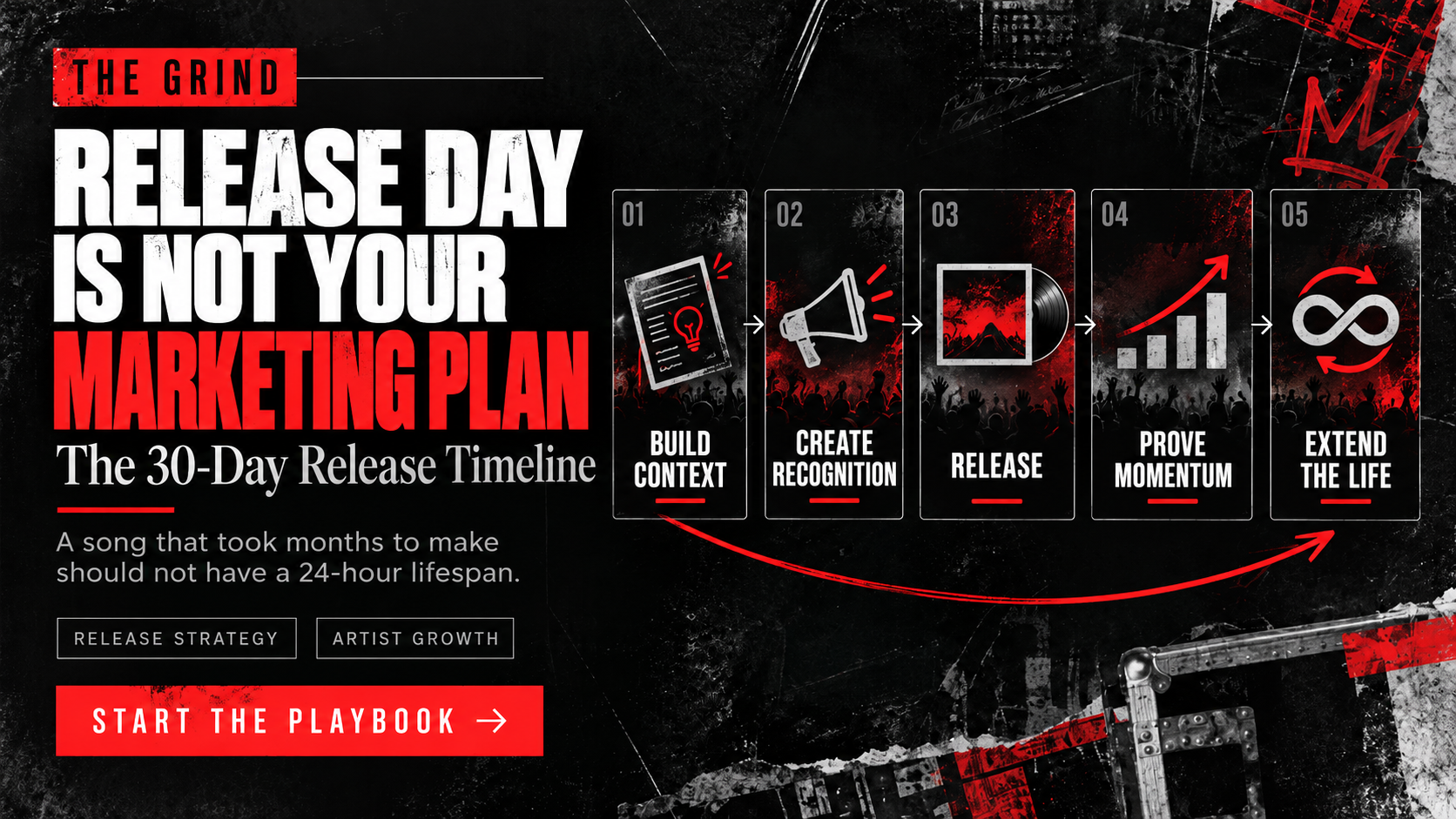
THE 30-DAY RELEASE TIMELINE
Build Context
Introduce the idea before asking anyone to hear the song. Show artwork, tell the origin story, establish the emotional or visual world.
Create Recognition
Use snippets, lyric moments, behind-the-scenes footage, press outreach, rehearsal clips, and repeated visual cues.
Release
Make the song easy to hear and the next action obvious. Do not bury the actual music underneath launch graphics.
Prove Momentum
Share reactions, reviews, playlists, fan posts, performances, data points, and new angles that tell people the release is still moving.
Extend the Life
Use acoustic versions, live performances, remixes, lyric breakdowns, alternate edits, collaborations, or a second visual.
Before release: teach people what to notice
The best pre-release content creates familiarity. By the time the song arrives, the title, artwork, lyric, or melody should already feel recognizable.
Recognition reduces friction. You are no longer introducing a completely unknown object on release day.
After release: stop repeating the same post
“Out now” has a short shelf life. The song itself contains dozens of possible stories: the vocal take, one lyric, one instrument, one reaction, the first live performance, the moment the idea started, or the part that changed in the studio.
Build your post-release inventory now.
Write down 10 things about your song that are not “it is out now.” Each becomes a future post, short-form clip, email, or conversation starter.
Your campaign should outlive the announcement
If the song deserves months of writing, production, mixing and mastering, it deserves more than a single day of attention. Build enough context before release and enough proof after release that the track has room to travel.
Keep reading
Back to The Grind ↗
From this section
Beyond the Directory: ROSTR’s Expansion and the Rise of Algorithmic Music Industry Networking
October 10, 2026
From this section
The Grind: Build a Fan Ladder That Gives Listeners a Next Step
October 9, 2026
From this section