
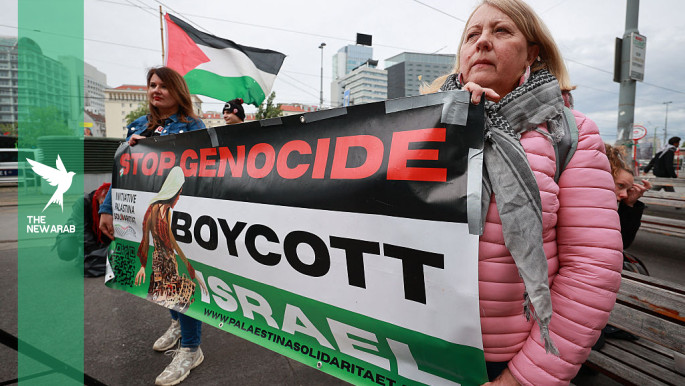
VIENNA — The first semi-final of the Eurovision Song Contest 2026 got off to a tense start on Tuesday night as Noam Bettan, representing Israel with his song “Michelle,” performed against a backdrop of crowd disruption — chants of “Stop the genocide,” audible booing, and vocal counter-support from other sections of the audience at Vienna’s Wiener Stadthalle.
Despite the divided reaction, Bettan advanced to Saturday’s grand final. Before taking the stage, he had said publicly that he intended to keep any criticism as “background noise.” The European Broadcasting Union (EBU) and Austrian host broadcaster ORF confirmed afterward that one audience member positioned near a microphone — who had been loudly expressing views before and during the performance — was removed by security. Three additional spectators were removed for disruptive behaviour.
Austrian public broadcaster ORF had previously confirmed it would not deploy anti-booing technology during the event — a tool used in prior years — meaning crowd noise was transmitted unfiltered on the live broadcast. Palestinian flags had been visible inside the arena during earlier rehearsals.
Bettan, 28, performed “Michelle” as his tenth-place entry in a lineup of 15 competing countries. The song — written partly in French, Hebrew, and English — was delivered in a production built around a large diamond-like stage structure. He was accompanied by five backup dancers and concluded his performance by addressing the crowd directly: “Thank you Europe, I love you.”
Bettan also received a formal warning from Eurovision organisers after footage circulated of him encouraging viewers in multiple languages to use all ten of their available semi-final votes to support his entry. Eurovision director Martin Green confirmed the violation and stated that the EBU had contacted the relevant delegation within 20 minutes and requested that the videos be taken down immediately across all platforms.
- 5 countries boycotted Eurovision 2026 over Israel’s participation — Ireland, Spain, Slovenia, Iceland, and the Netherlands.
- 4 spectators removed by security during Bettan’s semi-final performance, per EBU and ORF.
- 10 countries advanced from Semi-Final 1: Israel, Greece, Finland, Belgium, Sweden, Moldova, Croatia, Serbia, Lithuania, and Poland.
- 5 countries eliminated: Portugal, Georgia, Montenegro, Estonia, and San Marino.
- Grand Final: Saturday, May 17, 2026 — Vienna. Bookmakers favour Finland, then Greece and Denmark.
Eurovision’s 70th anniversary edition has been shadowed throughout by protests over Israel’s military actions in Gaza. Demonstrations took place across Vienna during the week, and the venue operated with airport-style security checks. The EBU continued to describe the contest as its biggest live music event, but the atmosphere inside the arena made clear how difficult it has become to isolate a song competition from an active geopolitical conflict.
The controversy extended beyond Israel’s entry. Boy George performed as a guest on San Marino’s act alongside veteran competitor Senhit, though their entry did not qualify for the final. Boy George had publicly stated that he believed music should unite people, while also making clear he did not feel politically aligned with Israel’s government — a position that drew its own share of commentary in the press.
The BBC’s live broadcast coverage also generated backlash. Presenter Angela Scanlon faced criticism from viewers across the political spectrum — some accusing the broadcaster of injecting political commentary into the coverage, others taking issue with how the hostility in the arena was characterised. BBC presenter Rylan Clark acknowledged on-air that Israel’s participation had prompted other countries to withdraw. Scanlon later remarked that “some of the audience seemed to be giving their opinions on Israel’s continued participation.”
The second semi-final takes place Thursday, with ten further countries set to qualify before Saturday’s grand final lineup is complete.
Reporting drawn from Prism News, the Evening Standard (via AOL UK), and GB News. EBU and ORF statements cited directly. No Israeli-affiliated outlets were used in the preparation of this article.