Metallica Was Right. Napster Changed Everything.
September 3, 2026 · 7 minutes read
The band defended artists’ control over their work. The file-sharing revolution exposed what listeners wanted. The music business still owes creators a better answer.
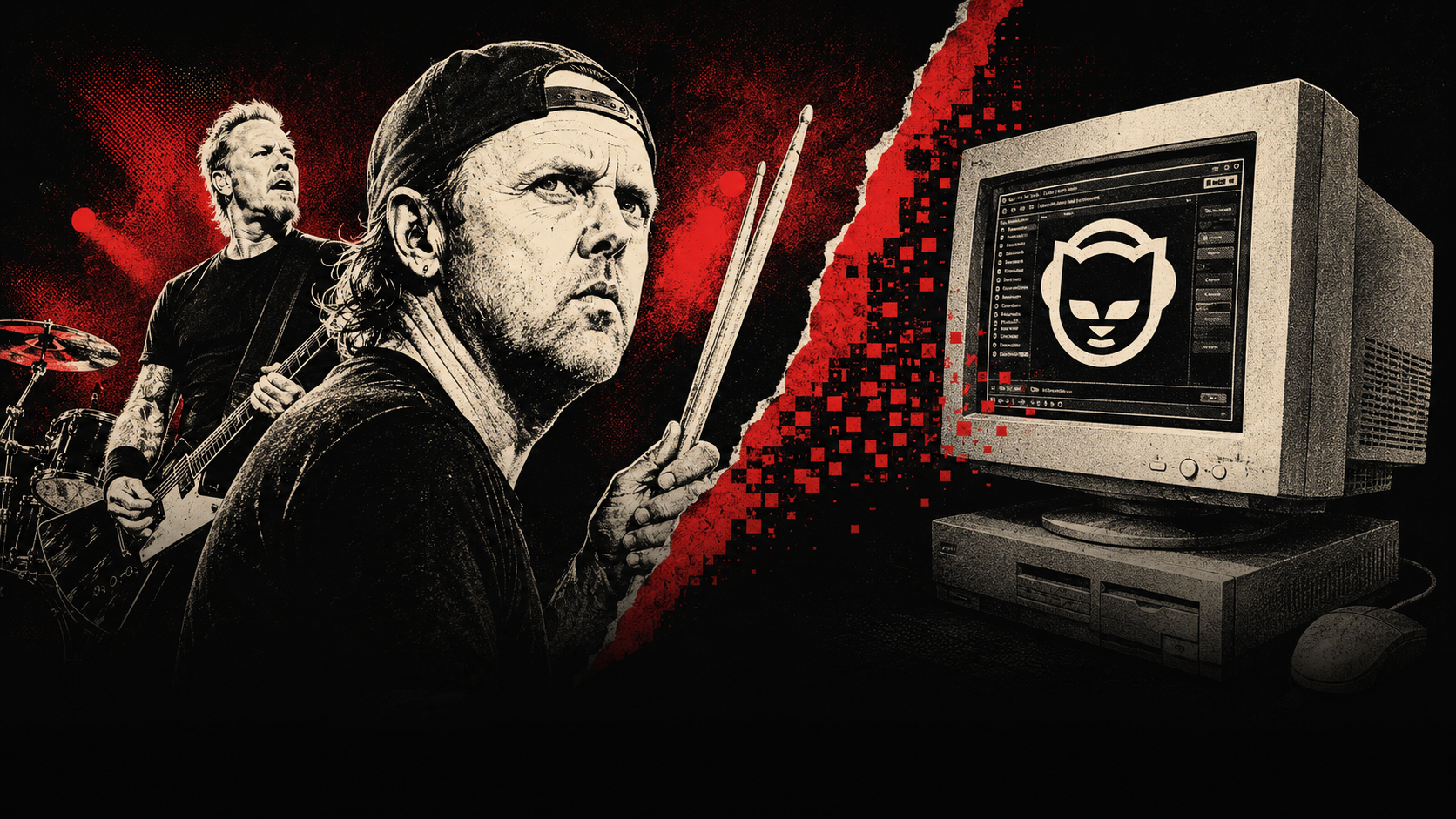
Metallica wanted a say in how its music reached the public. Napster users wanted a song without a trip to the record store. Between those two demands sat a music industry whose business model was about to come apart.
The fight became personal. Wealthy rock stars against their own fans. Technology against the establishment. Lars Ulrich became a convenient face for everything people resented about the business of music.
Those caricatures made choosing a side easy. They made understanding the conflict harder. Musicians deserved control over their work. Listeners had discovered a way to find and collect music that made the familiar alternatives feel restrictive. Both things could be true.
Looking back, Metallica deserves credit for defending that first principle. Napster deserves recognition for making the second impossible to ignore. Giving either side the entire victory misses why the argument still matters.
What Metallica was defending
Metallica filed its lawsuit against Napster on April 13, 2000. The record labels’ case had already begun in December 1999, so the idea that one band single-handedly saved the industry goes further than the history supports. Metallica became a highly visible participant in a fight already underway. WIRED’s lawsuit retrospective, U.S. Copyright Office’s contemporaneous brief.
The band’s central argument was straightforward: making music easy to copy did not give another company permission to distribute it on the artist’s behalf.
At a July 2000 Senate hearing, Ulrich put it plainly: “We should decide what happens to our music.” He acknowledged the possibilities of the internet while objecting to losing that decision. Senate hearing transcript.
That principle should sound familiar to any independent musician. An artist might release a track for free, offer downloads to fans, or use a song to promote a tour. Those can be deliberate choices with real value. Having the choice made for you is a different proposition.
An artist’s success does not make that distinction disappear. If control over creative work depends on whether the public thinks its creator already has enough money, it becomes a popularity contest. The principle should hold for a stadium band and a musician recording after a shift at work.
Metallica’s tactics still deserve scrutiny. The campaign resulted in more than 300,000 Napster users being banned, making the dispute painfully personal for listeners. Defending the band’s underlying position does not require endorsing every move it made. WIRED’s contemporary reporting on the bans.
A band can have a legitimate grievance and handle its audience badly. Fans can feel alienated without acquiring the right to decide how the band’s recordings are distributed.
What Napster revealed
The original Napster helped users locate and copy MP3 files from one another’s computers. It was peer-to-peer file sharing, distinct from the licensed streaming services that later became familiar. That distinction matters when we talk about its legacy. U.S. Copyright Office’s description of the service.
Its appeal is easy to understand. Imagine hearing about an unfamiliar band and searching for it that night. Finding an old favorite without tracking down a physical copy. Exploring music beyond what happened to be stocked locally or played on the radio.
Free access was a powerful attraction. It would be dishonest to explain the phenomenon entirely as a protest against inconvenient shopping. But reducing it to a hunger for free stuff overlooks the experience that made it compelling: search, discovery, individual songs, and a vast selection within reach of a computer.
Napster made that experience tangible. My reading of its legacy is that it helped force the industry to compete with a new expectation of access, even as it challenged the service in court.
There were already other digital experiments. At the same Senate hearing where Ulrich testified, witnesses discussed downloads, streaming, subscriptions, and remote music storage. Napster did not invent those possibilities. It intensified the urgency surrounding them. The July 2000 hearing.
The practical challenge was enormous: build an authorized experience that people would want to use after discovering what unauthorized access could offer.
The business changed. The question survived.
Apple launched the iTunes Music Store in April 2003 with individual downloads priced at 99 cents. It offered a prominent commercial answer to the demand for convenient, song-by-song purchasing. Spotify launched in 2008 after securing licensing agreements, bringing another approach to digital access. These were separate businesses and models, connected by the challenge of making music easy to obtain while accounting for rights. Apple’s launch announcement, Spotify’s company timeline.
That evolution complicates the old argument. Protecting copyright did not require keeping listeners tied to physical purchases forever. Improving access did not require treating permission as an obstacle that could simply be ignored.
The harder task was combining the two. It remains harder than a victory speech about technology defeating the record business—or the record business defeating piracy—would suggest.
What this means for independent artists
For Exposed Vocals, the most important person in this story is the musician trying to build a career today.
Digital distribution offers the possibility of reaching listeners far beyond a local scene. That opportunity matters. So does the distance between having music available, being discovered, and earning enough to keep making it.
Modern licensed streaming includes royalty payments. On Spotify, for example, payments go to rightsholders, with artists’ receipts affected by their agreements with labels or distributors. Spotify explicitly says it does not operate on one fixed per-stream royalty rate. A platform’s payout and a musician’s take-home income therefore cannot be treated as interchangeable figures. Spotify’s explanation of royalties.
That is where the old debate becomes useful again. Once the industry learned to deliver the access listeners wanted, how well did it protect the people supplying the music?
An independent artist should be able to ask that question without being dismissed as ungrateful for exposure. An audience is valuable. A sustainable relationship with that audience is more valuable still. Reaching someone should create a meaningful opportunity to build a career, not become the entire reward for the work.
Metallica was right to insist that musicians should have a say in what happens to their recordings. Napster demonstrated how powerfully people wanted music to move beyond the limits of its existing distribution. Taking both lessons seriously means demanding progress that respects the creator as much as the customer.
This Halloween, that history gets a personal next chapter. Metallica is bringing its Life Burns Faster residency to Sphere in Las Vegas, and I’ll be there on October 31, 2026.
Seeing the band embrace a new concert setting feels like a fitting reminder of the distinction at the heart of this piece: artists can welcome new ways to reach an audience while still expecting a say in how their work is used. I’m looking forward to experiencing that next chapter as a fan.
The next independent artist does not need us to settle an old argument about Lars Ulrich. They need us to carry its most important question forward: who benefits when music becomes easier to access?
The industry learned how to put a world of music within reach. Its unfinished work is making sure the people creating that world can afford to keep going.
Keep reading
Back to The Grind ↗
From this section
Beyond the Directory: ROSTR’s Expansion and the Rise of Algorithmic Music Industry Networking
October 10, 2026
From this section
The Grind: Build a Fan Ladder That Gives Listeners a Next Step
October 9, 2026
From this section